MUTEX — Mutual exclusive peripheral
The MUTEX peripheral uses mutual exclusion to support locking a resource that is shared between different CPUs in the system. The shared resource can only be used by one of these cores during the duration that it is locked.
The MUTEX peripheral includes several mutex registers. Each mutex register contains one bit which indicates if it is in a locked or unlocked state. Reading or writing to a mutex register may impact its state.
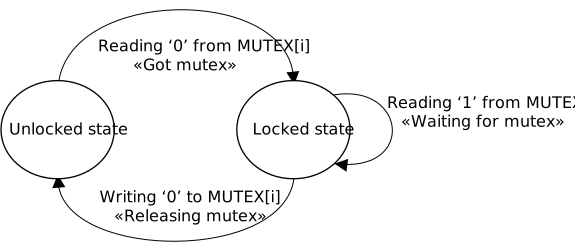
- If the state is locked, the MUTEX[i] state is unchanged (remains in a locked state) and reading the register will return '1'.
- If the state is unlocked, the MUTEX[i] state changes to the locked state and reading the register will return '0'.
- If the state is unlocked, the MUTEX[i] state is unchanged (remains in unlocked state) and the store is ignored.
- If the state is locked, the MUTEX[i] state changes to the unlocked state.
The following figure illustrates the mutex state transitions.
The following code is an example of how a mutex can be used by two different CPUs:
  // CPU0 Polling the MUTEX[0] register
  while (NRF_MUTEX->MUTEX[0]){ // Read MUTEX[0]
                               // If a 0 is read, the mutex will lock
                               // If a 1 is read, polling will continue
  }
  // CPU0 working on shared data related to the mutex
   ...
  NRF_MUTEX->MUTEX[0] = 0;  // Release the mutex
  // CPU1 Polling the MUTEX[0] register
  while (NRF_MUTEX->MUTEX[0]){ // Read MUTEX[0]
                               // If a 0 is read, the mutex will lock
                               // If a 1 is read, polling will continue
  }
  // CPU1 working on shared data related to the mutex
   ...
  NRF_MUTEX->MUTEX[0] = 0;  // Release the mutex
Only one CPU can access the mutex at a time, meaning the mutex must be released before being accessed by the another CPU. If the load operation occurs at the same time, a bus arbitration mechanism will ensure only one CPU gets the mutex.
Registers
Instances
| Instance | Domain | Base address | TrustZone | Split access | Description | ||
|---|---|---|---|---|---|---|---|
| Map | Att | DMA | |||||
MUTEX : S | APPLICATION | 0x50030000 | US | S | NA | No | Mutual exclusive hardware support |
APPMUTEX : S | NETWORK | 0x50030000 | US | S | NA | No | Mutex control |
Register overview
| Register | Offset | TZ | Description |
|---|---|---|---|
| MUTEX[n] | 0x400 | Mutex register |
MUTEX[n] (n=0..15)
Address offset: 0x400 + (n × 0x4)
Mutex register
| Bit number | 31 | 30 | 29 | 28 | 27 | 26 | 25 | 24 | 23 | 22 | 21 | 20 | 19 | 18 | 17 | 16 | 15 | 14 | 13 | 12 | 11 | 10 | 9 | 8 | 7 | 6 | 5 | 4 | 3 | 2 | 1 | 0 | |||
|---|---|---|---|---|---|---|---|---|---|---|---|---|---|---|---|---|---|---|---|---|---|---|---|---|---|---|---|---|---|---|---|---|---|---|---|
| ID | A | ||||||||||||||||||||||||||||||||||
| Reset 0x00000000 | 0 | 0 | 0 | 0 | 0 | 0 | 0 | 0 | 0 | 0 | 0 | 0 | 0 | 0 | 0 | 0 | 0 | 0 | 0 | 0 | 0 | 0 | 0 | 0 | 0 | 0 | 0 | 0 | 0 | 0 | 0 | 0 | |||
| ID | R/W | Field | Value ID | Value | Description | ||||||||||||||||||||||||||||||
| A | RW | MUTEX | Mutex register n | ||||||||||||||||||||||||||||||||
Unlocked | 0 | Mutex n is in unlocked state | |||||||||||||||||||||||||||||||||
Locked | 1 | Mutex n is in locked state | |||||||||||||||||||||||||||||||||