TrustZone security
The security architecture is based on Arm TrustZone.
The Arm Cortex-M based CPU supports Arm TrustZone for secure, non-secure, and non-secure callable memory regions.
The security attribution unit (SAU) and implementation defined attribution unit (IDAU) define the access permissions based on the security state.
The IDAU configuration divides system memory space into secure (S) and non-secure (NS) regions. The SAU provides configurable regions for the Arm Cortex-M CPU, and is used to define non-secure callable (NSC) regions.
IDAU preset configuration
| Memory map name | Address map | IDAU TrustZone security attribute |
|---|---|---|
| Private peripheral bus | 0xE0000000 – 0xFFFFFFFF | Not applicable |
| Device memory | 0xA0000000 – 0xDFFFFFFF | NS |
| External memory | 0x60000000 – 0xAFFFFFFF | NS |
| Peripheral (secure) | 0x50000000 – 0x5FFFFFFF | S |
| Peripheral (non-secure) | 0x40000000 – 0x4FFFFFFF | NS |
| Data memory | 0x20000000 – 0x3FFFFFFF | NS |
| Program memory | 0x00000000 – 0x1FFFFFFF | NS |
SAU configuration
The Arm Cortex-M33 CPU must configure its SAU regions when the CPU starts. The CPU assumes the memory map is secure before configuring the SAU regions.
SAU configuration registers are documented in the Arm Cortex-M33 Technical Reference Manual.
TrustZone security attributes
| IDAU security attribute | SAU security attribute | Security attribute result |
|---|---|---|
| S | NS, NSC, or S | S |
| NS, NSC, or S | S | S |
| NS | NS | NS |
| NS | NSC | NSC |
For the memory region that contains the secure gateway instruction branch veneers (entry points), the TrustZone security attribute seen by the Arm Cortex-M must be NSC for the secure functions that are callable from a non-secure program.
Example memory map
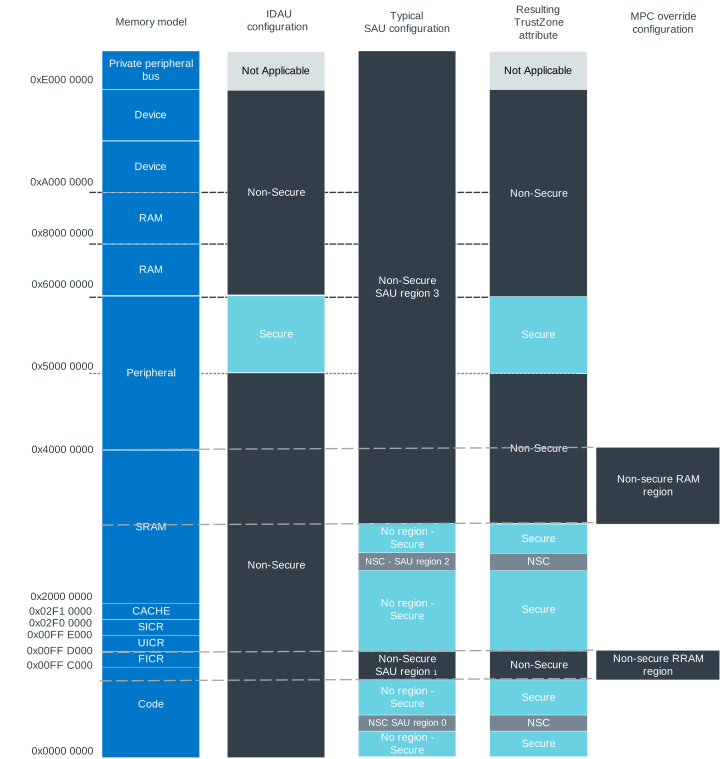
TrustZone security access
| Arm Cortex-M TrustZone security attribute | Destination address security attribute | Secure fault | Access allowed |
|---|---|---|---|
| S | S | No | Yes |
| S | NS | No | Yes |
| NS | NS | No | Yes |
| NS | S | Yes | No |
The first two columns show the TrustZone security attribute from the TrustZone security attributes table.
The Arm Cortex-M TrustZone security attribute is the TrustZone security attribute seen by the Arm Cortex-M CPU while executing a program. This shows if the Arm Cortex-M CPU program is executed from S, NS, or NSC memory. The NSC for the Arm Cortex-M TrustZone security attribute behaves same as S in the table.
The destination address security attribute is the TrustZone security attribute of the destination address lookup from the SAU and IDAU. It is used by the Arm Cortex-M CPU on the bus transaction.