nRF54LM20A | nRF54LM20B Datasheet
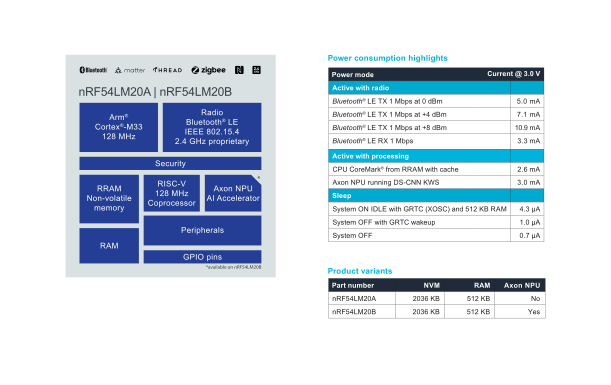
nRF54LM20A and nRF54LM20B are part of the nRF54L Series of wireless System on Chips (SoCs). Every device in the series integrates an ultra-low power, multiprotocol 2.4 GHz radio with MCU (Microcontroller Unit) functionality featuring a 128 MHz Arm®Cortex®-M33 processor. The nRF54LM20B variant includes an Axon Neural Processing Unit (NPU) - an edge AI accelerator. nRF54LM20A and nRF54LM20B feature an extended peripheral set including high-speed USB, increased memory size with 2036 KB NVM and 512 KB RAM, and up to 66 GPIO pins.
Nordic Semiconductor’s proprietary technology, such as low-leakage RAM and a cutting-edge multiprotocol radio design, enables ultra-low power consumption, reducing battery size or extending battery life.
Designed with versatility in mind, the nRF54L Series SoCs enable a broad range of applications. The multiprotocol 2.4 GHz radio supports Bluetooth® LE with optional features including Channel Sounding introduced in Bluetooth Core 6.0, as well as 802.15.4-2020 for standards such as Thread®, Matter, and Zigbee®, and a proprietary 2.4 GHz mode supporting up to 4 Mbps for higher throughput. The devices integrate the peripherals expected in a wireless microcontroller, enabling many products to be implemented with a single chip. An integrated RISC-V coprocessor further reduces the need for external ICs.
nRF54LM20A and nRF54LM20B enable demanding Bluetooth LE devices, as well as smart home and industrial applications, which require more memory, advanced features, and high GPIO counts.
The nRF54LM20B Axon NPU provides acceleration in edge AI applications such as health, biometric and activity tracking, voice control and audio classification, and low-fidelity vision.
- 128 MHz Arm Cortex-M33 processor
- 2036 KB NVM and 512 KB RAM
- Multiprotocol 2.4 GHz radio supporting Bluetooth LE, 802.15.4-2020, and 2.4 GHz proprietary modes (up to 4 Mbps)
- Seven serial interfaces (SPI, TWI, UART)
- High-speed USB interface
- Extended set of interfaces, peripherals, and timers including Global RTC available in System OFF, ADC, TDM, PDM, NFC, PWM, and QDEC
- 128 MHz RISC-V coprocessor
- Advanced security including TrustZone® isolation, tamper detection, and cryptographic engine with side-channel leakage protection
- Ultra-compact CSP and QFN packages
Radio
| Peripherals
| GPIO
|
Chapters
- Revision history
- About this document
- Document status
- Peripheral chapters
- Register overview table
- Register tables
- Registers
- Product overview
- Block diagram
- Memory and package overview
- Power domains
- Address format
- Memory
- CPU
- CPUC — CPU control
- Instantiation
- AMBA interconnect (AMBIX)
- EasyDMA
- CACHE — Instruction/data cache
- FICR — Factory information configuration registers
- MEMCONF — Memory configuration
- RRAMC — Resistive random access memory controller
- SICR — Secure information configuration region
- SWI — Software interrupts
- UICR — User information configuration registers
- Power and clock management
- System ON mode
- System OFF mode
- Power supply supervisors
- CLOCK — Clock control
- OSCILLATORS — Oscillator control
- POWER — Power control
- REGULATORS — Regulator control
- RESET — Reset control
- USBREG — USB regulator control
- Event system
- DPPI latencies
- DPPI — Distributed programmable peripheral interconnect
- PPIB — PPI Bridge
- Security
- Memory and peripheral access permissions
- TrustZone security
- Immutable boot region
- Security attributes
- Security fault
- Peripherals with split security access
- Physical security
- CRACEN — Cryptographic accelerator engine
- GLITCHDET — Voltage glitch detectors
- KMU — Key management unit
- MPC — Memory Privilege Controller
- SPU — System protection unit
- TAMPC — Tamper controller
- Peripherals
- Peripheral interface
- Instantiation
- AAR — Accelerated address resolver
- AXONS — Neural processing unit
- CCM — AES CCM mode encryption
- COMP — Comparator
- ECB — AES electronic codebook mode encryption
- EGU — Event generator unit
- GPIO — General purpose input/output
- GPIOTE — GPIO tasks and events
- GRTC — Global real-time counter
- LPCOMP — Low-power comparator
- NFCT — Near field communication tag
- PDM — Pulse density modulation interface
- PWM — Pulse width modulation
- QDEC — Quadrature decoder
- RADIO — 2.4 GHz radio
- SAADC — Successive approximation analog-to-digital converter
- SPIM — Serial peripheral interface controller with EasyDMA
- SPIS — Serial peripheral interface target with EasyDMA
- TDM — Time division multiplexed audio interface
- TEMP — Temperature sensor
- TIMER — Timer/counter
- TWIM — I2C compatible two-wire interface controller with EasyDMA
- TWIS — I2C compatible two-wire interface target with EasyDMA
- UARTE — Universal asynchronous receiver/transmitter with EasyDMA
- USBHS — Universal Serial Bus High Speed
- VPR — RISC-V CPU
- WDT — Watchdog timer
- Debug and trace
- Debug access port
- Access port protection
- Debug Interface mode
- Real-time debug
- Multidrop serial wire debug
- Trace
- CTRL-AP — Control access port
- TAD — Trace and debug control
- ETM — Embedded trace macrocell
- TPIU — Trace port interface unit
- Pin assignments
- CSP61 (CAAA) package
- CSP98 (PAAA) package
- QFN52 (QGAA) package
- Reference circuitry
- Package thermal characteristics
- Electrical specifications
- Conditions
- Current consumption
- AXONS Electrical specification
- CLOCK Electrical specification
- COMP Electrical specification
- CPU Electrical specification
- GPIO Electrical specification
- LPCOMP Electrical specification
- NFCT Electrical specification
- OSCILLATORS Electrical specification
- PPI Electrical specification
- PDM Electrical specification
- QDEC Electrical specification
- RADIO Electrical specification
- REGULATORS Electrical specification
- RESET Electrical specification
- RRAMC Electrical specification
- SAADC Electrical specification
- SPIM Electrical specification
- SPIS Electrical specification
- SWDP Electrical specification
- TEMP Electrical specification
- TDM Electrical specification
- TWIM Electrical specification
- TWIS Electrical specification
- UARTE Electrical specification
- USBHS Electrical specification
- WDT Electrical specification
- Recommended operating conditions
- Light sensitivity
- Absolute maximum ratings
- Device marking
- Order code
- Code ranges and values
- Product options
- Preprogrammed firmware
- Legal notices