LTE modem
The nRF9151 SiP contains a Low-Power Wide-Area (LPWA) network processor with dedicated flash memory and RAM, which controls the radio and baseband hardware components. After installing Nordic Semiconductor firmware, long term evolution (LTE) capabilities are available and comply with release 14 of the 3GPP LTE Cat-M1 and Cat-NB1/NB2 standards and release 17 of the 3GPP IoT NTN standard.
The key features of the LTE modem are the following:
- Complete modem with baseband and RF transceiver
- 3GPP release 14 compliant LTE categories:
- Cat-M1 (eMTC – enhanced machine type communication)
- Cat-NB1 (NB-IoT – narrowband Internet of things)
- Cat-NB2 (NB-IoT)
- 3GPP release 17 compliant LTE categories:
- Internet of Things Non-Terrestrial Network (IoT NTN)
- IoT NTN is based on Cat-NB1/NB2
- Power saving modes
- Supports LTE bands from 700 MHz to 2.2 GHz through a single 50 Ω antenna pin
- 1.8 V MIPI RF Front-End (MIPI RFFE) digital control interface and MAGPIO control interface for external RF applications
- LTE modem internal ADC for some AT command interface services
- 1.8 V UICC (universal integrated circuit card) interface, based on ISO/IEC 7816-3 that is
compliant with the following:
- UICC (ETSI TS 102 221)
- eUICC (ETSI TS 103 383)
The following figure is an overview of the key components of the LTE modem.
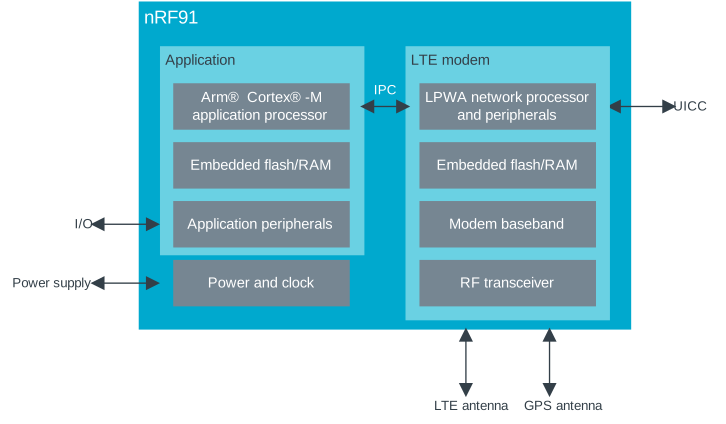
These components provide functions for the LTE L1, L2, and L3 (layers 1, 2, and 3 respectively), as well as IP communication layers. Peripherals provide hardware services for the LPWA network processor operating system and ensure a secure execution environment.
Application and LPWA network domains interact through the interprocessor communication (IPC) mechanism. The LTE modem is accessible through the modem API.
The application processor is the system manager and is responsible for starting and stopping the LTE modem. The LPWA network processor enables the clocks and power required for operation while the platform handles shared resources, such as clocks. When a hard fault is detected in the modem, the application domain will perform a hard reset of the modem.
The nRF9151 LTE modem feature set is dependent on the modem firmware version and the application firmware. For more information on the LTE modem API, see nRF Connect SDK API documentation and nRF91 AT Commands.