CRYPTOCELL — ARM TrustZone CryptoCell 310
ARM® TrustZone® CryptoCell 310 (CRYPTOCELL) is a security subsystem which provides root of trust (RoT) and cryptographic services for a device.
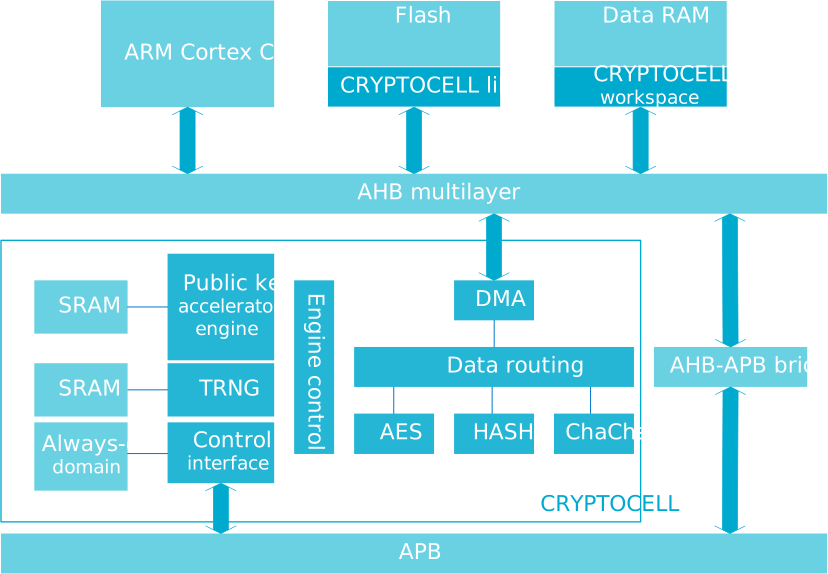
The following cryptographic features are provided:
- True random number generator (TRNG) compliant with NIST 800-90B, AIS-31, and FIPS 140-2
- Pseudorandom number generator (PRNG) using underlying AES engine compliant with NIST 800-90A
- RSA public key cryptography
- Up to 2048-bit key size
- PKCS#1 v2.1/v1.5
- Optional CRT support
- Elliptic curve cryptography (ECC)
- NIST FIPS 186-4 recommended curves using pseudorandom parameters, up to 521 bits:
- Prime field: P-192, P-224, P-256, P-384, P-521
- SEC 2 recommended curves using pseudorandom parameters, up to 521 bits:
- Prime field: secp160r1, secp192r1, secp224r1, secp256r1, secp384r1, secp521r1
- Koblitz curves using fixed parameters, up to 256 bits:
- Prime field: secp160k1, secp192k1, secp224k1, secp256k1
- Edwards/Montgomery curves:
- Ed25519, Curve25519
- ECDH/ECDSA support
- NIST FIPS 186-4 recommended curves using pseudorandom parameters, up to 521 bits:
- Secure remote password protocol (SRP)
- Up to 3072-bit operations
- Hashing functions
- SHA-1, SHA-2 up to 256 bits
- Keyed-hash message authentication code (HMAC)
- AES symmetric encryption
- General purpose AES engine (encrypt/decrypt, sign/verify)
- 128-bit key size
- Supported encryption modes: ECB, CBC, CMAC/CBC-MAC, CTR, CCM/CCM* (CCM* is a minor variation of CCM)
- ChaCha20/Poly1305 symmetric encryption
- Supported key size: 128 and 256 bits
- Authenticated encryption with associated data (AEAD) mode
Usage
The CRYPTOCELL state is controlled via a register interface. The cryptographic functions of CRYPTOCELL are accessible by using a software library provided in the device SDK, not directly via a register interface.
To enable CRYPTOCELL, use register ENABLE.
Always-on (AO) power domain
The CRYPTOCELL subsystem has an internal always-on (AO) power domain for retaining device secrets when CRYPTOCELL is disabled.
- 4 bits indicating the configured CRYPTOCELL lifecycle state (LCS)
- 1 bit indicating if the hard-coded RTL key, KPRTL (see RTL key), is available for use
- 128-bit device root key, KDR (see Device root key)
A reset from any reset source will erase the content in the AO power domain.
Lifecycle state (LCS)
Lifecycle refers to multiple states a device goes through during its lifetime. Two valid lifecycle states are offered for the device - debug and secure.
The CRYPTOCELL subsystem lifecycle state (LCS) is controlled through register HOST_IOT_LCS. A valid LCS is configured by writing either value Debug or Secure into the LCS field of this register. A correctly configured LCS can be validated by reading back the read-only field LCS_IS_VALID from the abovementioned register. The LCS_IS_VALID field value will change from Invalid to Valid once a valid LCS value has been written.
| LCS field value | LCS_IS_VALID field value | Description |
|---|---|---|
| Secure | Invalid | Default reset value indicating that LCS has not been configured. |
| Secure | Valid | LCS set to secure mode, and LCS is valid. Registers HOST_IOT_KDR[0..3] can only be written once per reset cycle. Any additional writes will be ignored. |
| Debug | Valid | LCS set to debug mode, and LCS is valid. Registers HOST_IOT_KDR[0..3] can be written multiple times. |
Cryptographic key selection
The CRYPTOCELL subsystem can be instructed to operate on different cryptographic keys.
- RTL key KPRTL
- Device root key KDR
- Session key
KPRTL and KDR are configured as part of the CRYPTOCELL initialization process, while session keys are provided by the application through the software library API.
RTL key
The ARM® TrustZone® CryptoCell 310 contains one hard-coded RTL key referred to as KPRTL. This key is set to the same value for all devices with the same part code in the hardware design and cannot be changed.
The KPRTL key can be requested for use in cryptographic operations by the CRYPTOCELL, without revealing the key value itself. Access to use of KPRTL in cryptographic operations can be disabled until next reset by writing to register HOST_IOT_KPRTL_LOCK. If a locked KPRTL key is requested for use, a zero vector key will be routed to the AES engine instead.
Device root key
The device root key KDR is a 128-bit AES key programmed into the CRYPTOCELL subsystem using firmware. It is retained in the AO power domain until the next reset.
Once configured, it is possible to perform cryptographic operations using the CRYPTOCELL subsystem where KDR is selected as key input without having access to the key value itself. The KDR key value must be written to registers HOST_IOT_KDR[0..3]. These 4 registers are write-only if LCS is set to debug mode, and write-once if LCS is set to secure mode. The KDR key value is successfully retained when the read-back value of register HOST_IOT_KDR0 changes to 1.
Direct memory access (DMA)
The CRYPTOCELL subsystem implements direct memory access (DMA) for accessing memory without CPU intervention.
Any data stored in memory type(s) not accessible by the DMA engine must be copied to SRAM before it can be processed by the CRYPTOCELL subsystem. Maximum DMA transaction size is limited to 216-1 bytes.
Standards
ARM® TrustZone® CryptoCell 310 (CRYPTOCELL) supports a number of cryptography standards.
| Algorithm family | Identification code | Document title |
|---|---|---|
| TRNG | NIST SP 800-90B | Recommendation for the Entropy Sources Used for Random Bit Generation |
| AIS-31 | A proposal for: Functionality classes and evaluation methodology for physical random number generators | |
| FIPS 140-2 | Security Requirements for Cryptographic Modules | |
| PRNG | NIST SP 800-90A | Recommendation for Random Number Generation Using Deterministic Random Bit Generators |
| Stream cipher | Chacha | ChaCha, a variant of Salsa20, Daniel J. Bernstein, January 28th 2008 |
| MAC | Poly1305 | The Poly1305-AES message-authentication code, Daniel J. Bernstein Cryptography in NaCl, Daniel J. Bernstein |
| Key agreement | SRP | The Secure Remote Password Protocol, Thomas Wu, November 11th 1997 |
| AES | FIPS-197 | Advanced Encryption Standard (AES) |
| NIST SP 800-38A | Recommendation for Block Cipher Modes of Operation - Methods and Techniques | |
| NIST SP 800-38B | Recommendation for Block Cipher Modes of Operation: The CMAC Mode for Authentication | |
| NIST SP 800-38C | Recommendation for Block Cipher Modes of Operation: The CCM Mode for Authentication and Confidentiality | |
| ISO/IEC 9797-1 | AES CBC-MAC per ISO/IEC 9797-1 MAC algorithm 1 | |
| IEEE 802.15.4-2011 | IEEE Standard for Local and metropolitan area networks - Part 15.4: Low-Rate Wireless Personal Area Networks (LR-WPANs), Annex B.4: Specification of generic CCM* mode of operation | |
| Hash | FIPS 180-3 | Secure Hash Standard (SHA1, SHA-224, SHA-256) |
| RFC2104 | HMAC: Keyed-Hashing for Message Authentication | |
| RSA | PKCS#1 | Public-Key Cryptography Standards (PKCS) #1: RSA Cryptography Specifications v1.5/2.1 |
| Diffie-Hellman | ANSI X9.42 | Public Key Cryptography for the Financial Services Industry: Agreement of Symmetric Keys Using Discrete Logarithm Cryptography |
| PKCS#3 | Diffie-Hellman Key-Agreement Standard | |
| ECC | ANSI X9.63 | Public Key Cryptography for the Financial Services Industry - Key Agreement and Key Transport Using Elliptic Curve Cryptography |
| IEEE 1363 | Standard Specifications for Public-Key Cryptography | |
| ANSI X9.62 | Public Key Cryptography For The Financial Services Industry: The Elliptic Curve Digital Signature Algorithm (ECDSA) | |
| Ed25519 | Edwards-curve, Ed25519: high-speed high-security signatures, Daniel J. Bernstein, Niels Duif, Tanja Lange, Peter Schwabe, and Bo-Yin Yang | |
| Curve25519 | Montgomery curve, Curve25519: new Diffie-Hellman speed records, Daniel J. Bernstein | |
| FIPS 186-4 | Digital Signature Standard (DSS) | |
| SEC 2 | Recommended Elliptic Curve Domain Parameters, Certicom Research | |
| NIST SP 800-56A rev. 2 | Recommendation for Pair-Wise Key Establishment Schemes Using Discrete Logarithm Cryptography |
Registers
Instances
| Instance | Base address | TrustZone | Split access | Description | ||
|---|---|---|---|---|---|---|
| Map | Att | DMA | ||||
| CRYPTOCELL | 0x50840000 | HF | S | NSA | No | CryptoCell sub-system control interface |
Register overview
| Register | Offset | TZ | Description |
|---|---|---|---|
| ENABLE | 0x500 | Enable CRYPTOCELL subsystem |
ENABLE
Address offset: 0x500
Enable CRYPTOCELL subsystem
| Bit number | 31 | 30 | 29 | 28 | 27 | 26 | 25 | 24 | 23 | 22 | 21 | 20 | 19 | 18 | 17 | 16 | 15 | 14 | 13 | 12 | 11 | 10 | 9 | 8 | 7 | 6 | 5 | 4 | 3 | 2 | 1 | 0 | |||
|---|---|---|---|---|---|---|---|---|---|---|---|---|---|---|---|---|---|---|---|---|---|---|---|---|---|---|---|---|---|---|---|---|---|---|---|
| ID | A | ||||||||||||||||||||||||||||||||||
| Reset 0x00000000 | 0 | 0 | 0 | 0 | 0 | 0 | 0 | 0 | 0 | 0 | 0 | 0 | 0 | 0 | 0 | 0 | 0 | 0 | 0 | 0 | 0 | 0 | 0 | 0 | 0 | 0 | 0 | 0 | 0 | 0 | 0 | 0 | |||
| ID | R/W | Field | Value ID | Value | Description | ||||||||||||||||||||||||||||||
| A | RW | ENABLE | Enable or disable the CRYPTOCELL subsystem | ||||||||||||||||||||||||||||||||
Disabled | 0 | CRYPTOCELL subsystem disabled | |||||||||||||||||||||||||||||||||
Enabled | 1 | CRYPTOCELL subsystem enabled. When enabled the CRYPTOCELL subsystem can be initialized and controlled through the CryptoCell firmware API. | |||||||||||||||||||||||||||||||||
Host interface
This chapter describes host registers used to control the CRYPTOCELL subsystem behavior.
HOST_RGF block
The HOST_RGF block contains registers for configuring LCS and device root key KDR, in addition to selecting which cryptographic key is connected to the AES engine.
Registers
Instances
| Instance | Base address | TrustZone | Split access | Description | ||
|---|---|---|---|---|---|---|
| Map | Att | DMA | ||||
| CC_HOST_RGF | 0x50840000 | HF | S | NSA | No | Host platform interface |
Register overview
| Register | Offset | TZ | Description |
|---|---|---|---|
| HOST_CRYPTOKEY_SEL | 0x1A38 | AES hardware key select | |
| HOST_IOT_KPRTL_LOCK | 0x1A4C | This write-once register is the K_PRTL lock register. When this register is set, K_PRTL cannot be used and a zeroed key will be used instead. The value of this register is saved in the CRYPTOCELL AO power domain. | |
| HOST_IOT_KDR0 | 0x1A50 | This register holds bits 31:0 of K_DR. The value of this register is saved in the CRYPTOCELL AO power domain. Reading from this address returns the K_DR valid status indicating if K_DR is successfully retained. | |
| HOST_IOT_KDR1 | 0x1A54 | This register holds bits 63:32 of K_DR. The value of this register is saved in the CRYPTOCELL AO power domain. | |
| HOST_IOT_KDR2 | 0x1A58 | This register holds bits 95:64 of K_DR. The value of this register is saved in the CRYPTOCELL AO power domain. | |
| HOST_IOT_KDR3 | 0x1A5C | This register holds bits 127:96 of K_DR. The value of this register is saved in the CRYPTOCELL AO power domain. | |
| HOST_IOT_LCS | 0x1A60 | Controls lifecycle state (LCS) for CRYPTOCELL subsystem |
HOST_CRYPTOKEY_SEL
Address offset: 0x1A38
AES hardware key select
| Bit number | 31 | 30 | 29 | 28 | 27 | 26 | 25 | 24 | 23 | 22 | 21 | 20 | 19 | 18 | 17 | 16 | 15 | 14 | 13 | 12 | 11 | 10 | 9 | 8 | 7 | 6 | 5 | 4 | 3 | 2 | 1 | 0 | |||
|---|---|---|---|---|---|---|---|---|---|---|---|---|---|---|---|---|---|---|---|---|---|---|---|---|---|---|---|---|---|---|---|---|---|---|---|
| ID | A | A | |||||||||||||||||||||||||||||||||
| Reset 0x00000000 | 0 | 0 | 0 | 0 | 0 | 0 | 0 | 0 | 0 | 0 | 0 | 0 | 0 | 0 | 0 | 0 | 0 | 0 | 0 | 0 | 0 | 0 | 0 | 0 | 0 | 0 | 0 | 0 | 0 | 0 | 0 | 0 | |||
| ID | R/W | Field | Value ID | Value | Description | ||||||||||||||||||||||||||||||
| A | RW | HOST_CRYPTOKEY_SEL | Select the source of the HW key that is used by the AES engine | ||||||||||||||||||||||||||||||||
K_DR | 0 | Use device root key K_DR from CRYPTOCELL AO power domain | |||||||||||||||||||||||||||||||||
K_PRTL | 1 | Use hard-coded RTL key K_PRTL | |||||||||||||||||||||||||||||||||
Session | 2 | Use provided session key | |||||||||||||||||||||||||||||||||
HOST_IOT_KPRTL_LOCK
Address offset: 0x1A4C
This write-once register is the K_PRTL lock register. When this register is set, K_PRTL cannot be used and a zeroed key will be used instead. The value of this register is saved in the CRYPTOCELL AO power domain.
| Bit number | 31 | 30 | 29 | 28 | 27 | 26 | 25 | 24 | 23 | 22 | 21 | 20 | 19 | 18 | 17 | 16 | 15 | 14 | 13 | 12 | 11 | 10 | 9 | 8 | 7 | 6 | 5 | 4 | 3 | 2 | 1 | 0 | |||
|---|---|---|---|---|---|---|---|---|---|---|---|---|---|---|---|---|---|---|---|---|---|---|---|---|---|---|---|---|---|---|---|---|---|---|---|
| ID | A | ||||||||||||||||||||||||||||||||||
| Reset 0x00000000 | 0 | 0 | 0 | 0 | 0 | 0 | 0 | 0 | 0 | 0 | 0 | 0 | 0 | 0 | 0 | 0 | 0 | 0 | 0 | 0 | 0 | 0 | 0 | 0 | 0 | 0 | 0 | 0 | 0 | 0 | 0 | 0 | |||
| ID | R/W | Field | Value ID | Value | Description | ||||||||||||||||||||||||||||||
| A | RW | HOST_IOT_KPRTL_LOCK | This register is the K_PRTL lock register. When this register is set, K_PRTL cannot be used and a zeroed key will be used instead. The value of this register is saved in the CRYPTOCELL AO power domain. | ||||||||||||||||||||||||||||||||
Disabled | 0 | K_PRTL can be selected for use from register HOST_CRYPTOKEY_SEL | |||||||||||||||||||||||||||||||||
Enabled | 1 | K_PRTL has been locked until next power-on reset (POR). If K_PRTL is selected anyway, a zeroed key will be used instead. | |||||||||||||||||||||||||||||||||
HOST_IOT_KDR0
Address offset: 0x1A50
This register holds bits 31:0 of K_DR. The value of this register is saved in the CRYPTOCELL AO power domain. Reading from this address returns the K_DR valid status indicating if K_DR is successfully retained.
| Bit number | 31 | 30 | 29 | 28 | 27 | 26 | 25 | 24 | 23 | 22 | 21 | 20 | 19 | 18 | 17 | 16 | 15 | 14 | 13 | 12 | 11 | 10 | 9 | 8 | 7 | 6 | 5 | 4 | 3 | 2 | 1 | 0 | |||
|---|---|---|---|---|---|---|---|---|---|---|---|---|---|---|---|---|---|---|---|---|---|---|---|---|---|---|---|---|---|---|---|---|---|---|---|
| ID | A | A | A | A | A | A | A | A | A | A | A | A | A | A | A | A | A | A | A | A | A | A | A | A | A | A | A | A | A | A | A | A | |||
| Reset 0x00000000 | 0 | 0 | 0 | 0 | 0 | 0 | 0 | 0 | 0 | 0 | 0 | 0 | 0 | 0 | 0 | 0 | 0 | 0 | 0 | 0 | 0 | 0 | 0 | 0 | 0 | 0 | 0 | 0 | 0 | 0 | 0 | 0 | |||
| ID | R/W | Field | Value ID | Value | Description | ||||||||||||||||||||||||||||||
| A | RW | HOST_IOT_KDR0 | Write: K_DR bits 31:0. Read: 0x00000000 when 128-bit K_DR key value is not yet retained in the CRYPTOCELL AO power domain. Read: 0x00000001 when 128-bit K_DR key value is successfully retained in the CRYPTOCELL AO power domain. | ||||||||||||||||||||||||||||||||
HOST_IOT_KDR1
Address offset: 0x1A54
This register holds bits 63:32 of K_DR. The value of this register is saved in the CRYPTOCELL AO power domain.
| Bit number | 31 | 30 | 29 | 28 | 27 | 26 | 25 | 24 | 23 | 22 | 21 | 20 | 19 | 18 | 17 | 16 | 15 | 14 | 13 | 12 | 11 | 10 | 9 | 8 | 7 | 6 | 5 | 4 | 3 | 2 | 1 | 0 | |||
|---|---|---|---|---|---|---|---|---|---|---|---|---|---|---|---|---|---|---|---|---|---|---|---|---|---|---|---|---|---|---|---|---|---|---|---|
| ID | A | A | A | A | A | A | A | A | A | A | A | A | A | A | A | A | A | A | A | A | A | A | A | A | A | A | A | A | A | A | A | A | |||
| Reset 0x00000000 | 0 | 0 | 0 | 0 | 0 | 0 | 0 | 0 | 0 | 0 | 0 | 0 | 0 | 0 | 0 | 0 | 0 | 0 | 0 | 0 | 0 | 0 | 0 | 0 | 0 | 0 | 0 | 0 | 0 | 0 | 0 | 0 | |||
| ID | R/W | Field | Value ID | Value | Description | ||||||||||||||||||||||||||||||
| A | W | HOST_IOT_KDR1 | K_DR bits 63:32 | ||||||||||||||||||||||||||||||||
HOST_IOT_KDR2
Address offset: 0x1A58
This register holds bits 95:64 of K_DR. The value of this register is saved in the CRYPTOCELL AO power domain.
| Bit number | 31 | 30 | 29 | 28 | 27 | 26 | 25 | 24 | 23 | 22 | 21 | 20 | 19 | 18 | 17 | 16 | 15 | 14 | 13 | 12 | 11 | 10 | 9 | 8 | 7 | 6 | 5 | 4 | 3 | 2 | 1 | 0 | |||
|---|---|---|---|---|---|---|---|---|---|---|---|---|---|---|---|---|---|---|---|---|---|---|---|---|---|---|---|---|---|---|---|---|---|---|---|
| ID | A | A | A | A | A | A | A | A | A | A | A | A | A | A | A | A | A | A | A | A | A | A | A | A | A | A | A | A | A | A | A | A | |||
| Reset 0x00000000 | 0 | 0 | 0 | 0 | 0 | 0 | 0 | 0 | 0 | 0 | 0 | 0 | 0 | 0 | 0 | 0 | 0 | 0 | 0 | 0 | 0 | 0 | 0 | 0 | 0 | 0 | 0 | 0 | 0 | 0 | 0 | 0 | |||
| ID | R/W | Field | Value ID | Value | Description | ||||||||||||||||||||||||||||||
| A | W | HOST_IOT_KDR2 | K_DR bits 95:64 | ||||||||||||||||||||||||||||||||
HOST_IOT_KDR3
Address offset: 0x1A5C
This register holds bits 127:96 of K_DR. The value of this register is saved in the CRYPTOCELL AO power domain.
| Bit number | 31 | 30 | 29 | 28 | 27 | 26 | 25 | 24 | 23 | 22 | 21 | 20 | 19 | 18 | 17 | 16 | 15 | 14 | 13 | 12 | 11 | 10 | 9 | 8 | 7 | 6 | 5 | 4 | 3 | 2 | 1 | 0 | |||
|---|---|---|---|---|---|---|---|---|---|---|---|---|---|---|---|---|---|---|---|---|---|---|---|---|---|---|---|---|---|---|---|---|---|---|---|
| ID | A | A | A | A | A | A | A | A | A | A | A | A | A | A | A | A | A | A | A | A | A | A | A | A | A | A | A | A | A | A | A | A | |||
| Reset 0x00000000 | 0 | 0 | 0 | 0 | 0 | 0 | 0 | 0 | 0 | 0 | 0 | 0 | 0 | 0 | 0 | 0 | 0 | 0 | 0 | 0 | 0 | 0 | 0 | 0 | 0 | 0 | 0 | 0 | 0 | 0 | 0 | 0 | |||
| ID | R/W | Field | Value ID | Value | Description | ||||||||||||||||||||||||||||||
| A | W | HOST_IOT_KDR3 | K_DR bits 127:96 | ||||||||||||||||||||||||||||||||
HOST_IOT_LCS
Address offset: 0x1A60
Controls lifecycle state (LCS) for CRYPTOCELL subsystem
| Bit number | 31 | 30 | 29 | 28 | 27 | 26 | 25 | 24 | 23 | 22 | 21 | 20 | 19 | 18 | 17 | 16 | 15 | 14 | 13 | 12 | 11 | 10 | 9 | 8 | 7 | 6 | 5 | 4 | 3 | 2 | 1 | 0 | |||
|---|---|---|---|---|---|---|---|---|---|---|---|---|---|---|---|---|---|---|---|---|---|---|---|---|---|---|---|---|---|---|---|---|---|---|---|
| ID | B | A | A | A | |||||||||||||||||||||||||||||||
| Reset 0x00000002 | 0 | 0 | 0 | 0 | 0 | 0 | 0 | 0 | 0 | 0 | 0 | 0 | 0 | 0 | 0 | 0 | 0 | 0 | 0 | 0 | 0 | 0 | 0 | 0 | 0 | 0 | 0 | 0 | 0 | 0 | 1 | 0 | |||
| ID | R/W | Field | Value ID | Value | Description | ||||||||||||||||||||||||||||||
| A | RW | LCS | Lifecycle state value. This field is write-once per reset. | ||||||||||||||||||||||||||||||||
Debug | 0 | CC310 operates in debug mode | |||||||||||||||||||||||||||||||||
Secure | 2 | CC310 operates in secure mode | |||||||||||||||||||||||||||||||||
| B | RW | LCS_IS_VALID | Read-only field. Indicates if CRYPTOCELL LCS has been successfully configured since last reset. | ||||||||||||||||||||||||||||||||
Invalid | 0 | Valid LCS not yet retained in the CRYPTOCELL AO power domain | |||||||||||||||||||||||||||||||||
Valid | 1 | Valid LCS successfully retained in the CRYPTOCELL AO power domain | |||||||||||||||||||||||||||||||||