20. Graphic processor unit (GPU)
20.1 Introduction
The GPU is a dedicated graphics processing unit accelerating numerous 3D graphics applications such as graphical user interface (GUI), menu display or animations.
It works together with an optimized software stack design for industry-standard APIs with support for Android and Linux embedded development platforms.
20.2 GPU main features
3D hardware features:
- • OpenGL ES 2.0 / 1.1 compliance, including extensions; OpenVG 1.1
- • IEEE 32-bit floating-point pipeline
- • Ultra-threaded, unified vertex and fragment (pixel) shaders
- • Low bandwidth at both high and low data rates
- • Low CPU loading
- • Up to 12 programmable elements per vertex
- • Dependent texture operation with high-performance
- • Alpha blending
- • Depth and stencil compare
- • Support for 8 fragment shader simultaneous textures
- • Support for 4 vertex shader simultaneous textures
- • Point sampling, bi-linear sampling, tri-linear filtering, and cubic textures
- • 8k x 8k texture size and 8 k x 8 k rendering target
- • 4 Vertex DMA streams
API support:
- • OpenGL ES 1.1 and 2.0
- • OpenVG 1.1
- • EGL 1.4
- • OpenGL 2.1
20.3 GPU general description
The block diagram of the GPU is shown in Figure 137.
Figure 137. GPU block diagram
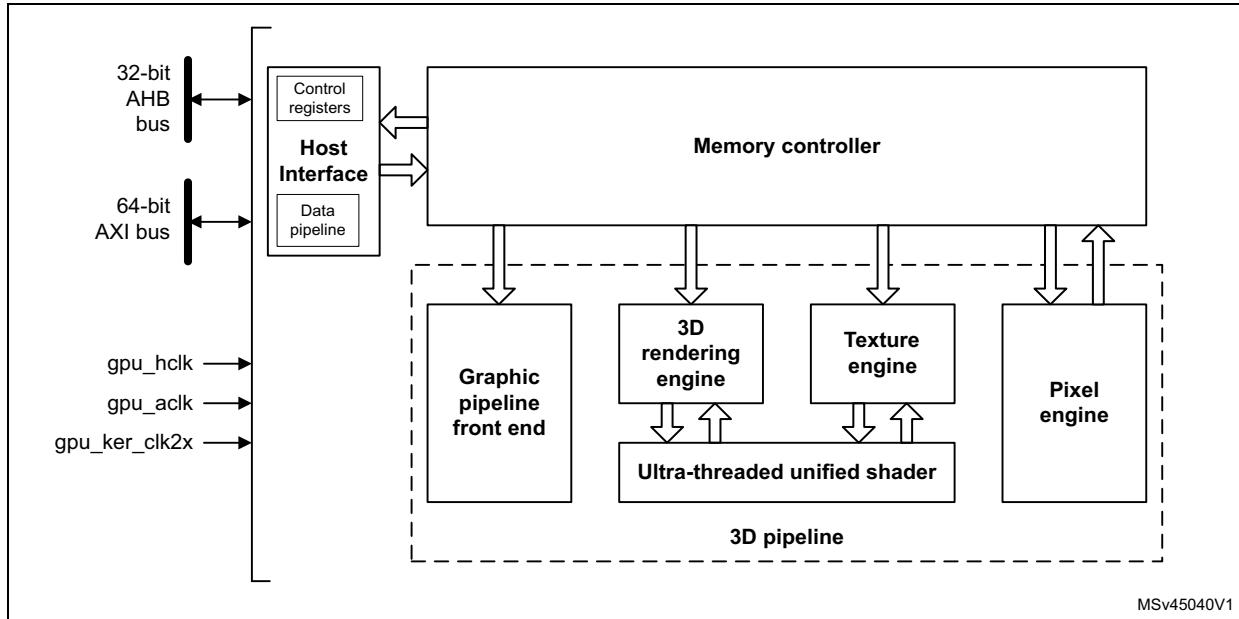
The diagram illustrates the internal architecture of the GPU. On the left, external interfaces are shown: a 32-bit AHB bus and a 64-bit AXI bus, both connected to a Host Interface block. The Host Interface contains Control registers and a Data pipeline. Below these are three clock inputs: gpu_hclk, gpu_aclk, and gpu_ker_clk2x. The Host Interface is connected to a Memory controller. The Memory controller is connected to a 3D pipeline, which is enclosed in a dashed box. The 3D pipeline consists of a Graphic pipeline front end, a 3D rendering engine, a Texture engine, and a Pixel engine. The 3D rendering engine and Texture engine are connected to an Ultra-threaded unified shader block. The Memory controller has bidirectional data paths to the Graphic pipeline front end, 3D rendering engine, Texture engine, and Pixel engine. The Ultra-threaded unified shader has bidirectional data paths to the 3D rendering engine and Texture engine. The Pixel engine has a bidirectional data path to the Memory controller.
MSv45040V1