11. Resource isolation slave unit for address space protection (full version) (RISAF)
11.1 RISAF introduction
The RIF (resource isolation framework) is a comprehensive set of hardware blocks designed to enforce and manage isolation of STM32 hardware resources, like memory and peripherals.
Through RISAF registers, a trusted domain application or the application to whom the configuration has been delegated, assigns memory regions and subregions to one or more security domains (secure, privileged, compartment).
RISAF includes the DDR memory cipher engine (DDRMCE) feature.
11.2 RISAF main features
- • Assign variable sized address space regions and subregions to security domains.
- • Make memory regions:
- – Restricted to one or more than one hardware compartments
- – Secure-only or nonsecure-only
- – Privileged-only or privileged/unprivileged
- – Read-only, write-only, or read/write
- • The trusted domain can delegate configuration and positioning of a subregion (within a region) to another security domain.
- • The trusted domain can delegate configuration and positioning of a subregion (within a nonsecure region) to a nonsecure privileged software.
- • Support of special debug domain with greater accesses in either secure or nonsecure
- • When applicable, the DDRMCE can encrypt/decrypt on-the-fly the traffic going to/from the DDR-SDRAM.
11.3 RISAF implementation
The following table describes the characteristics of the available RISAFs, including watermark programming details (such as granularity and protected address space).
Table 49. RISAF resource assignment
| Protected memory | Resource name(1) | Number of base regions | Number of subregions per base region | Granularity (bytes) | Address space size and alignment(2) | DDRMCE option | Dual port option | Default protection(3) |
|---|---|---|---|---|---|---|---|---|
| BKPSRAM | RISAF1 | 4 | 2 | 256 | 8 Kbytes | No | No | Primary region only: secure, privileged, TDCID only |
| OCTOSPI2 | RISAF2 | 4 | 4096 | 256 Mbytes | ||||
| OCTOSPI1 | ||||||||
| PCIE | RISAF5 | 2 | 4 Gbytes | Yes(4) | Yes | |||
| DDR | RISAF4 | 15 | ||||||
- 1. According to the resource name, the reset value of RISAF_HWCFGR changes: 0x05080505 for RISAF1, 0x100C0505 for RISAF2, 0x140C1010 for RISAF4, and 0x100C0303 for RISAF5. Similarly, the reset value of RISAF_IPIDR is 0x00100166 for RISAF1 and RISAF2, and 0x00100167 for RISAF4 and RISAF5.
- 2. When address space size is the full 32-bit address space (4 Gbytes), watermarks are programmed using physical addresses, on 32 bits.
- 3. Default protection policy out of reset.
- 4. To be used for secure regions only. Encrypted regions are bypassed in case of tamper event, with the cypher key erased in case of confirmed tamper.
11.4 RISAF functional description
11.4.1 RISAF block diagram
The following figures show the block diagrams of the two RISAF types (single port or dual port with encryption) associated with the IAC, and optionally, a memory controller. Both types are programmed the same way.
Figure 31. RISAF block diagram (without DDRMCE)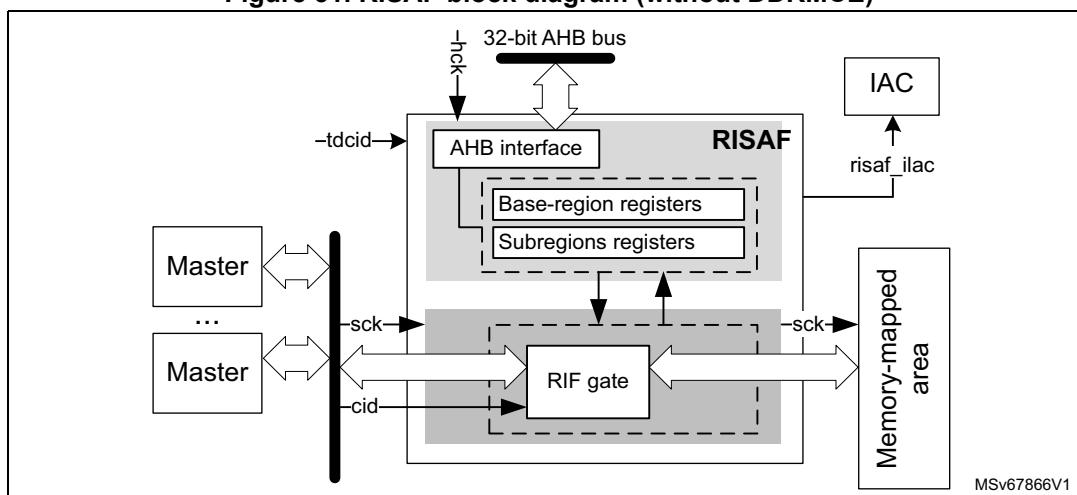
MSv67866V1
- 1. The tdcid input value is equal to CID.
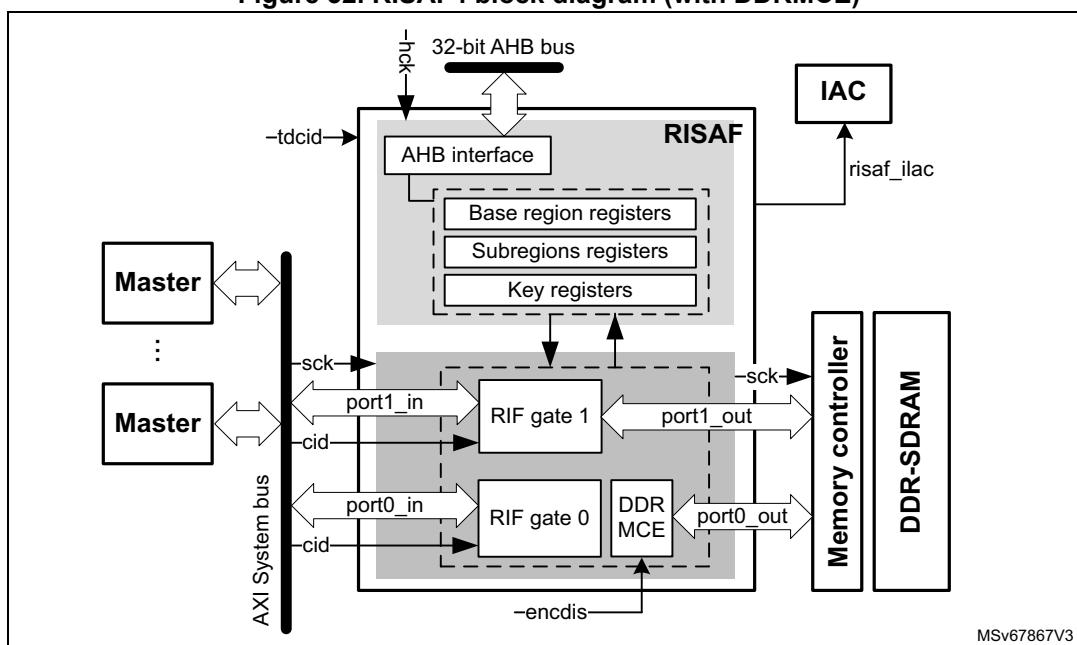
MSv67867V3
11.4.2 RISAF internal signals
Table 50 describes internal signals available at RISAF level, not at product level (on pins).
Table 50. RISAF internal input/output signals| Name | Type | Description |
|---|---|---|
| risaf_sck | Digital input | System bus clock, also used by the protected memory controller |
| risaf_hclk | AHB bus clock |
Table 50. RISAF internal input/output signals (continued)
| Name | Type | Description |
|---|---|---|
| risaf_ilac | Digital output | Illegal access signal to IAC |
| risaf_encdis | Digital input | Static control signal disabling encryption |
11.4.3 RISAF reset and clocks
The RISAF peripheral has two clocks, one for its AHB register interface, and one for its system bus interfaces. The system bus clock is shared with the system bus memory controller target.
The RISAF peripheral has a single reset input.
Address spaces protected by the RISAF are by default secure, privileged, and CID only.
11.4.4 RISAF address space management
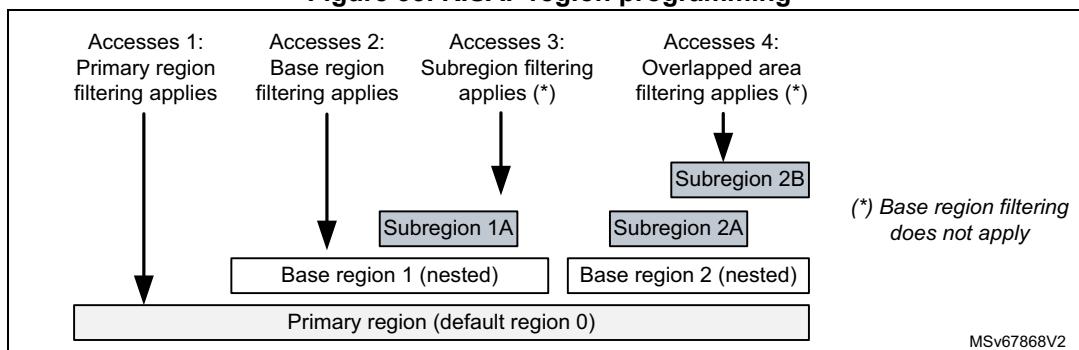
Through RISAF registers, a trusted domain application, or the application to which the configuration has been delegated, assigns memory regions to one or more security domains (secure, privilege, compartment ID). Figure 33 illustrates the principle of this allocation.
Figure 33. RISAF region programming
MSv67868V2
As shown in Figure 33, there are multiple types of access filtered by RISAF:
- • Accesses 1 - Default region: access to an area not belonging to any enabled base region. Filtering for such access is fixed to secure, privileged and CID only.
- • Accesses 2 - Application region > 0: access to an area in an enabled base region, not belonging to any enabled subregion. Filtering for such access is defined in the base region, where one or more compartments can be granted specific accesses.
- • Accesses 3 - Non overlapped subregion: access to an area in an enabled nested subregion. Filtering for such access is defined in the subregion, with only one compartment that can be granted access.
- • Accesses 4 - Overlapped subregion: accesses to an area overlapping two enabled nested subregions. In this case, filtering rules for these subregions are used by the RISAF as follows:
- – If both subregions are secure (resp. nonsecure), the overlap is secure (resp. nonsecure).
- – If one subregion is nonsecure (resp. unprivileged), the overlap is nonsecure (resp. unprivileged).
- – If one of the two subregions grants access to a compartment, the access can go through. Up to two compartments can be granted access to an overlapped subregion.
Note: When a base or subregion is disabled, the associated filtering is disabled as well. For access types 3 or 4 (detailed above), base region filtering rules do not apply.
As defined in Section 6.2: Resource isolation framework (RIF), a debug domain (privileged) must be granted the following accesses, depending on its security:
- • The secure debug domain can read and write anywhere in the address space protected by RISAF. It can also modify the registers reserved to the trusted domain.
- • For reads (resp. writes), the nonsecure debug domain can only access regions that are tagged by an application as nonsecure, readable (resp. writable) by at least one compartment.
Access rules to secure, nonsecure, privileged, and unprivileged memory regions are described in Section 6.2: Resource isolation framework (RIF).
11.4.5 RISAF programming
Only the trusted domain can set up the access configuration to base region x through RISAF_REGx_CFGR, RISAF_REGx_CIDCFGR, RISAF_REGx_STARTR, and RISAF_REGx_ENDR.
The trusted domain, or the application to which the subregion z configuration has been delegated in RISAF_REGx_zNESTR, can set up the access configuration to subregion z of base region x through RISAF_REGx_zCFGR, RISAF_REGx_zSTARTR, and RISAF_REGx_zENDR (z = A or B).
As shown in Table 51, subregion right options depend upon the base region privileged and security rights.
Table 51. RISAF subregion security setup matrix
| Base region rights | Nested subregion rights | |||
|---|---|---|---|---|
| Secure, privileged | Secure, unprivileged | Nonsecure, privileged | Nonsecure, unprivileged | |
| Secure, privileged | OK(1) | OK | OK | OK |
| Secure, unprivileged | Not allowed | OK(1) | Not allowed | OK |
| Nonsecure, privileged | Not allowed | Not allowed | OK(1) | OK |
| Nonsecure, unprivileged | Not allowed | Not allowed | Not allowed | OK(1) |
1. Default configuration
Configuring base regions in RISAF
If the trusted domain must use a base region x (for example at boot time), the following steps are recommended.
- 1. The trusted domain sets start and end addresses for each of the required base region x, using RISAF_REGx_STARTR and RISAF_REGx_ENDR:
- – These registers are initialized with 32-bit physical addresses when protected address space size is 4 Gbytes. For different sizes, refer to the register description.
- – Base regions must be defined within their primary region. The hardware enforces this rule if the application does not follow it.
- 2. For each of the above region x, the trusted domain programs RISAF_REGx_CIDCFGR, granting read and/or write access to any compartment.
- 3. For each of the above region x, the trusted domain finalizes the programming by configuring RISAF_REGx_CFGR, setting up security parameters (secure or encrypted if applicable), and granting privileged-only access, or not, to each compartment that has access to the region (see step 2).
- 4. After a final check on the above configuration, the trusted domain enables each required base region x, setting the BREN bit in RISAF_REGx_CFGR.
Note: The number of regions, the region watermark granularity, and the address space size depend upon the RISAF instance (see Section 11.3).
At any time the trusted domain can lock the RISAF configuration until the next reset, by setting the GLOCK bit in RISAF_CR. Subregion registers are the exception to this rule, as explained in Configuring subregions in RISAF.
If the RISAF instance supports encryption (see Section 11.3), and if the trusted application requires region x to be encrypted, the recommended steps are:
- • One AES key must be written to RISAF_KEYRy registers before step 4.
- • As an AES key is shared with all encrypted regions, it is recommended to have all these regions secure.
- • When ENCDIS = 1 in RISAF_SR, or when the AXI port that receives the transaction does not support encryption (see port 1 in Figure 32), all writes to this base region x are ignored and all read requests return 0 if ENC = BREN = 1 in RISAF_REGx_CFGR.
Configuring subregions in RISAF
Note: The number of subregions, the subregion watermark granularity, and the primary region address space size depend on the RISAF resource described in Section 11.3.
When an application needs to use the subregion z defined in the base region x, there are two configuration options in RISAF_REGx_zNESTR:
- • The trusted domain programs the RIF configuration for this subregion. In this case, DCEN is cleared.
- • The secure privileged software delegates the RIF configuration to a single CID, defined with DCCID. In this case, DCEN must also be set.
Configuring a subregion z consists in the following steps.
- 1. Define the start and end address of the subregion using RISAF_REGx_zSTARTR and RISAF_REGx_zENDR registers.
- – When programming subregion watermarks, use similar rules as for base regions (see Configuring base regions in RISAF).
- – Subregions must be defined within their base region. The RISAF enforces this rule if the application does not follow it.
- 2. Modify WREN and RDEN in RISAF_REGx_zCFGR to modify the access right of allowed compartment (defined with SCID bits).
- 3. In the same registers, modify the security and privileged access rights for the allowed compartment, if needed (see Table 51 for applicable restrictions).
- 4. After a final check on the above configuration, the subregion must be enabled by setting SREN bit in RISAF_REGx_zCFGR.
After a trusted domain has locked all base regions (using GLOCK bit), subregion owners can lock their configuration using the RLOCK bit in RISAF_REGx_zCFGR.
Note: Only a secure application can change SEC in RISAF_REGx_zCFGR. If the base region is secure, only a secure application can configure subregion registers.
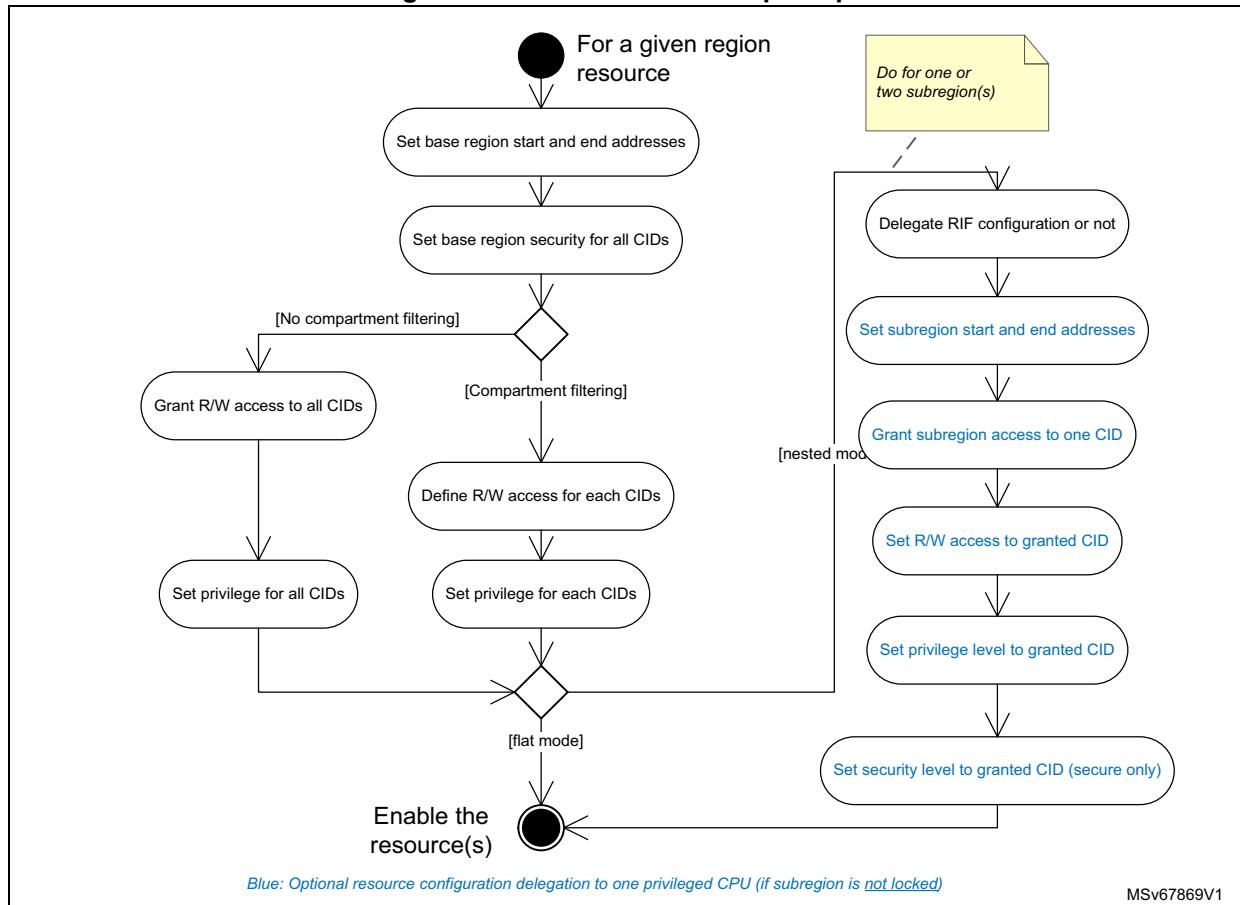
The overall RISAF initialization is summarized in Figure 34.
Figure 34. RISAF initialization principle
graph TD
    Start(( )) --> S1[Set base region start and end addresses]
    S1 --> S2[Set base region security for all CIDs]
    S2 --> D1{ }
    D1 -- "[No compartment filtering]" --> S3[Grant R/W access to all CIDs]
    S3 --> S4[Set privilege for all CIDs]
    D1 -- "[Compartment filtering]" --> S5[Define R/W access for each CIDs]
    S5 --> S6[Set privilege for each CIDs]
    S4 --> D2{ }
    S6 --> D2
    D2 -- "[flat mode]" --> End(( ))

    Note[Do for one or two subregion(s)] -.-> S7[Delegate RIF configuration or not]
    S7 --> S8[Set subregion start and end addresses]
    S8 --> S9[Grant subregion access to one CID]
    S9 --> S10[Set R/W access to granted CID]
    S10 --> S11[Set privilege level to granted CID]
    S11 --> S12[Set security level to granted CID (secure only)]
    S12 --> End
Blue: Optional resource configuration delegation to one privileged CPU (if subregion is not locked)
MSv67869V1
11.4.6 RISAF runtime modification of region or subregion configuration
The RISAF supports the on-the-fly update of the base region and subregion programming, except for the start- and end-address boundaries:
- • To change RISAF_REGx_STARTR and RISAF_REGx_ENDR, the base region must be disabled (BREN = 0). In this case, the default primary region access rules apply immediately (secure, privileged, CID only).
- • To change RISAF_REGx_zSTARTR and RISAF_REGx_zENDR (z = A or B), the subregion must be disabled (SREN = 0). In this case, the base region access rules apply immediately.
If the first solution introduces too many constraints, a workaround is shown in Figure 35.
Figure 35. RISAF region on-the-fly resizing
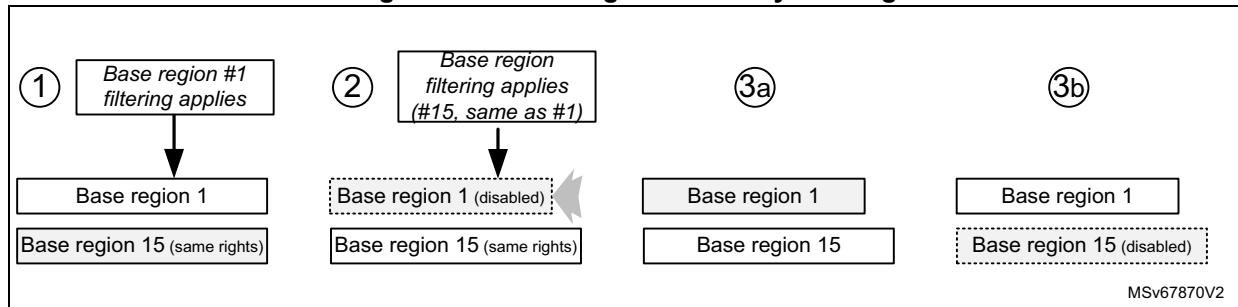
The diagram illustrates the process of on-the-fly resizing of base region 1. It consists of four stages labeled 1, 2, 3a, and 3b. In stage 1, 'Base region #1 filtering applies' to 'Base region 1' and 'Base region 15 (same rights)'. In stage 2, 'Base region filtering applies (#15, same as #1)' to 'Base region 15 (same rights)', while 'Base region 1' is disabled (indicated by a dashed box and a left-pointing arrow). In stage 3a, 'Base region 1' is enabled (solid box) and 'Base region 15' is disabled (dashed box). In stage 3b, 'Base region 1' is enabled (solid box) and 'Base region 15 (disabled)' is disabled (dashed box). The label 'MSv67870V2' is located in the bottom right corner of the diagram area.
The recommended on-the-fly resizing of base region 1 becomes:
- 1. Define a spare base region (for example 15), exactly as current region 1.
- 2. Disable region 1 by clearing BREN. The region 15 access control (identical to region 1) immediately applies. No effect is experienced at system level. The region 1 can be safely resized.
- 3. Enable region 1, then disable region 15. The new region 1 access control immediately applies. Optionally, subregions can be added on top.
11.4.7 Managing illegal accesses
As a RIF component, the RISAF does not use the standard interrupt lines toward NVIC or GIC concentrators. The IAC captures all RIF interrupt events, called illegal access events.
Refer to Section 12: Illegal access controller (IAC) for more information on the way illegal accesses are managed.
11.5 RISAF registers
The registers are accessible through the interface of the RISAF. Only word accesses (32 bits) are supported.
If the debug domain feature is activated and security and privileged policy allows it, the debug domain traffic goes through, regardless of any CID filtering policy. If the debug domain feature is de-activated the CID filtering policy also applies to debug domain traffic.
11.5.1 RISAF configuration register (RISAF_CR)
Address offset: 0x000
Reset value: 0x0000 0000
Secure, privileged, trusted domain CID, write access only. Any read access is allowed, writes are ignored if GLOCK is set.
| 11.5 11.5.1 | column_2 | column_3 | column_4 | column_5 | column_6 | column_7 | column_8 | column_9 | column_10 | column_11 | column_12 | column_13 | column_14 | column_15 | RM0457 |
|---|---|---|---|---|---|---|---|---|---|---|---|---|---|---|---|
| 31 | 30 | 29 | 28 | 27 | 26 | 25 | 24 | 23 | 22 | 21 | 20 | 19 | 18 | 17 | 16 |
| Res. | Res. | Res. | Res. | Res. | Res. | Res. | Res. | Res. | Res. | Res. | Res. | Res. | Res. | Res. | Res. |
| 15 | 14 | 13 | 12 | 11 | 10 | 9 | 8 | 7 | 6 | 5 | 4 | 3 | 2 | 1 | 0 |
| Res. | Res. | Res. | Res. | Res. | Res. | Res. | Res. | Res. | Res. | Res. | Res. | Res. | Res. | Res. | GLOCK rs |
| Bit 0 | GLOCK | : Global lock | |||||||||||||
| 31 | 30 | 29 | 28 | 27 | 26 | 25 | 24 | 23 | 22 | 21 | 20 | 19 | 18 | 17 | 16 |
| Res. | Res. | Res. | Res. | Res. | Res. | Res. | Res. | Res. | Res. | Res. | Res. | Res. | Res. | Res. | Res. |
| 15 | 14 | 13 | 12 | 11 | 10 | 9 | 8 | 7 | 6 | 5 | 4 | 3 | 2 | 1 | 0 |
| Res. | Res. | Res. | Res. | Res. | Res. | Res. | Res. | Res. | Res. | Res. | Res. | Res. | ENC | KEY | KEY |
| DIS | RDY | VALID | |||||||||||||
| r | r | r |
Bits 31:1 Reserved, must be kept at reset value.
Bit 0 GLOCK: Global lock
This bit locks the configuration of RISAF registers until next reset. It is cleared by default, and, once set, cannot be reset until global RISAF reset.
0: RISAF registers are writable.
1: All writes to RISAF registers are ignored, except RISAF_IACR, RISAF_REGx_zCFGR, RISAF_REGx_zSTARTR, and RISAF_REGx_zENDR (z = A to B).
11.5.2 RISAF status register (RISAF_SR)
Address offset: 0x004
Reset value: 0x0000 0000
Secure, privileged, trusted domain CID, read access only.
Bits 31:3 Reserved, must be kept at reset value.
Bit 2 ENCDIS: Encryption disabled
This bit is reserved if the encryption feature is not available in RISAF (see Section 11.3). It is a non-volatile product configuration that cannot be changed by software.
0: When ENC = BREN = 1 in RISAF_REGx_CFGR, all allowed write accesses in region x are encrypted, and all allowed read requests are decrypted.
1: When ENC = BREN = 1 in RISAF_REGx_CFGR, all write accesses in region x are ignored, and all read requests return 0. In other words, the AES feature of RISAF is unusable, for any region.
Note: If BREN = 0, the AES feature of RISAF is not usable for a given region.
Bit 1 KEYRDY: Key ready
This bit is reserved if the encryption feature is not available in RISAF (see Section 11.3).
0: The most recently written key in RISAF_KEYRy is being expanded
1: The most recently written key in RISAF_KEYRy is ready for use
Bit 0 KEYVALID: Key valid
This bit is reserved if the encryption feature is not available in RISAF (see Section 11.3).
0: A valid key has not been written in RISAF_KEYRy
1: A valid key has been written in RISAF_KEYRy
11.5.3 RISAF illegal access status register (RISAF_IASR)
Address offset: 0x008
Reset value: 0x0000 0000
Secure, privileged, trusted domain CID, read access only.
| 31 | 30 | 29 | 28 | 27 | 26 | 25 | 24 | 23 | 22 | 21 | 20 | 19 | 18 | 17 | 16 |
|---|---|---|---|---|---|---|---|---|---|---|---|---|---|---|---|
| Res. | Res. | Res. | Res. | Res. | Res. | Res. | Res. | Res. | Res. | Res. | Res. | Res. | Res. | Res. | Res. |
| 15 | 14 | 13 | 12 | 11 | 10 | 9 | 8 | 7 | 6 | 5 | 4 | 3 | 2 | 1 | 0 |
| Res. | Res. | Res. | Res. | Res. | Res. | Res. | Res. | Res. | Res. | Res. | Res. | Res. | IAEF1 | IAEF0 | CAEF |
| r | r | r |
Bits 31:3 Reserved, must be kept at reset value.
Bit 2 IAEF1: Illegal access error flag 1
This bit is reserved if the dual port feature is not available in the RISAF instance (see Section 11.3). The bit is set when an illegal access is detected by checker unit 1 on the system bus. More details on the error can be found in RISAF_IAESR1 and RISAF_IADDR1.
This bit is cleared by setting the corresponding bit in RISAF_IACR.
Bit 1 IAEF0: Illegal access error flag 0
This bit is set when an illegal access is detected by checker unit 0 on the system bus. More details on the error can be found in RISAF_IAESR0 and RISAF_IADDR0.
This bit is cleared by setting corresponding bit in RISAF_IACR.
Bit 0 CAEF: Configuration access error flag
This bit is set when an illegal access to any RISAF configuration register is detected. It is cleared by setting the corresponding bit in RISAF_IACR.
11.5.4 RISAF illegal access clear register (RISAF_IACR)
Address offset: 0x00C
Reset value: 0x0000 0000
Secure, privileged, trusted domain CID, write access only.
| 31 | 30 | 29 | 28 | 27 | 26 | 25 | 24 | 23 | 22 | 21 | 20 | 19 | 18 | 17 | 16 |
| Res. | Res. | Res. | Res. | Res. | Res. | Res. | Res. | Res. | Res. | Res. | Res. | Res. | Res. | Res. | Res. |
| 15 | 14 | 13 | 12 | 11 | 10 | 9 | 8 | 7 | 6 | 5 | 4 | 3 | 2 | 1 | 0 |
| Res. | Res. | Res. | Res. | Res. | Res. | Res. | Res. | Res. | Res. | Res. | Res. | Res. | IAEF1 | IAEF0 | CAEF |
| w | w | w |
Bits 31:3 Reserved, must be kept at reset value.
Bit 2 IAEF1: Illegal access error flag 1
This bit is reserved if the dual port feature is not available in the RISAF instance (see Section 11.3). Set this bit to clear IAEF1 in RISAF_IASR, allowing the capture of a new error information from RIF gate 1 in RISAF_IAESR1 and RISAF_IADDR1.
Note: Clearing this bit does not clear RISAB_IADDR1.
Bit 1 IAEF0: Illegal access error flag 0
Set this bit to clear IAEF0 in RISAF_IASR, allowing the capture of a new error information from RIF gate 0 in RISAF_IAESR0 and RISAF_IADDR0 registers.
Note: Clearing this bit does not clear RISAB_IADDR0.
Bit 0 CAEF: Configuration access error flag
Set this bit to clear CAEF in RISAF_IASR.
11.5.5 RISAF illegal access error status register x (RISAF_IAESRx)
Address offset: 0x020 + 0x8 * x (x = 0 to 1)
Reset value: 0x0000 0000
Secure, privileged, trusted domain CID, read access only.
Note: RISAF_IAESR1 is reserved if the dual port feature is not available in the RISAF instance (see Section 11.3).
| 31 | 30 | 29 | 28 | 27 | 26 | 25 | 24 | 23 | 22 | 21 | 20 | 19 | 18 | 17 | 16 |
| Res. | Res. | Res. | Res. | Res. | Res. | Res. | Res. | Res. | Res. | Res. | Res. | Res. | Res. | Res. | Res. |
| 15 | 14 | 13 | 12 | 11 | 10 | 9 | 8 | 7 | 6 | 5 | 4 | 3 | 2 | 1 | 0 |
| Res. | Res. | Res. | Res. | Res. | Res. | Res. | Res. | IANRW | Res. | IASEC | IAPRIV | Res. | IACID[2:0] | ||
| r | r | r | r | r | r | ||||||||||
Bits 31:8 Reserved, must be kept at reset value.
Bit 7 IANRW: Illegal access read/write
When IAEFx = 1 in RISAF_IASR, IANRW captures the access type of the illegal access that has been detected by RIF gate x.
- 0: Illegal access was a data read or an instruction fetch
- 1: Illegal access was a data write
Bit 6 Reserved, must be kept at reset value.
Bit 5 IASEC: Illegal access security
When IAEFx = 1 in RISAF_IASR, IASEC captures the security type of the illegal access that has been detected by RIF gate x.
- 0: Illegal access was nonsecure
- 1: Illegal access was secure
Bit 4 IAPRIV: Illegal access privileged
When IAEFx = 1 in RISAF_IASR, IAPRIV captures the privilege state of the master that issued the illegal access detected by RIF gate x.
- 0: Illegal access was unprivileged
- 1: Illegal access was privileged
Bit 3 Reserved, must be kept at reset value.
Bits 2:0 IACID[2:0]: Illegal access compartment ID
When IAEFx = 1 in RISAF_IASR, IACID[2:0] captures the compartment ID of the master that issued the illegal access detected by RIF gate x.
11.5.6 RISAF illegal address register x (RISAF_IADDRx)
Address offset: 0x024+0x8*x (x = 0 to 1)
Reset value: 0x0000 0000
Secure, privileged, trusted domain CID, read access only.
Note: RISAF_IADDR1 is reserved if the dual port feature is not available in the RISAF instance (see Section 11.3).
| 31 | 30 | 29 | 28 | 27 | 26 | 25 | 24 | 23 | 22 | 21 | 20 | 19 | 18 | 17 | 16 |
| IADD[31:16] | |||||||||||||||
| r | r | r | r | r | r | r | r | r | r | r | r | r | r | r | r |
| 15 | 14 | 13 | 12 | 11 | 10 | 9 | 8 | 7 | 6 | 5 | 4 | 3 | 2 | 1 | 0 |
| IADD[15:0] | |||||||||||||||
| r | r | r | r | r | r | r | r | r | r | r | r | r | r | r | r |
Bits 31:0 IADD[31:0]: Illegal address
When IAEFx = 1 in RISAFB_IASR, IADD[31:0] captures the address of the erroneous access through RIF gate x. Additional information can be found in RISAF_IAESRx. Captured address information is the byte offset from the base of the protected address space.
11.5.7 RISAF encryption key y (RISAF_KEYRy)
Address offset: 0x030+0x4*y (y = 0 to 3)
Reset value: 0x0000 0000
Secure, privileged, trusted domain CID, write access only. Writes are ignored if GLOCK is set in RISAF_CR.
Note: RISAF_KEYR0/1/2/3 are reserved if the DDRMCE feature is not available in the RISAF instance (see Section 11.3).
| 31 | 30 | 29 | 28 | 27 | 26 | 25 | 24 | 23 | 22 | 21 | 20 | 19 | 18 | 17 | 16 |
| KEY{i + 32 * y} | |||||||||||||||
| w | w | w | w | w | w | w | w | w | w | w | w | w | w | w | w |
| 15 | 14 | 13 | 12 | 11 | 10 | 9 | 8 | 7 | 6 | 5 | 4 | 3 | 2 | 1 | 0 |
| KEY{i + 32 * y} | |||||||||||||||
| w | w | w | w | w | w | w | w | w | w | w | w | w | w | w | w |
Bits 31:0 KEY{i + 32 * y}: Cryptographic key (i = 31 to 0)
This write-only bitfield contains the key used by the DDRMCE.
11.5.8 RISAF region x configuration register (RISAF_REGx_CFGR)
Address offset: 0x040 + 0x40 * (x - 1) (x = 1 to 15)
Reset value: 0x0000 0000
Secure, privileged, trusted domain CID, write access only. Any read access is allowed on this register. Writes are ignored if GLOCK is set in RISAF_CR.
Refer to Section 11.3 to verify the number of base regions supported by this RISAF instance.
| 31 | 30 | 29 | 28 | 27 | 26 | 25 | 24 | 23 | 22 | 21 | 20 | 19 | 18 | 17 | 16 |
| Res. | Res. | Res. | Res. | Res. | Res. | Res. | Res. | PRIV C7 | PRIV C6 | PRIV C5 | PRIV C4 | PRIV C3 | PRIV C2 | PRIV C1 | PRIV C0 |
| rw | rw | rw | rw | rw | rw | rw | rw | ||||||||
| 15 | 14 | 13 | 12 | 11 | 10 | 9 | 8 | 7 | 6 | 5 | 4 | 3 | 2 | 1 | 0 |
| ENC | Res. | Res. | Res. | Res. | Res. | Res. | SEC | Res. | Res. | Res. | Res. | Res. | Res. | Res. | BREN |
| rw | rw | rw |
Bits 31:24 Reserved, must be kept at reset value.
Bits 23:16 PRIVC[7:0]: Privileged access for compartment y (y = 7 to 0)
This bit is taken into account only if BREN = 1.
0: Application running in compartment y can access to region x in privileged and unprivileged mode.
1: Application running in compartment y can access to region x in privileged mode only.
Bit 15 ENC: Encrypted region
This bit is taken into account only if BREN = 1 and if the DDRMCE feature is available in RISAF (see ENCDIS in RISAF_SR and Section 11.3).
0: No effect
1: All allowed write accesses are encrypted and all allowed read requests are decrypted when KEYRDY = 1 in RISAF_SR (to be used for secure regions only).
Note: Key registers RISAF_KEYRy must be properly initialized before setting this bit (KEYVALID = 1 in RISAF_SR).
Bits 14:9 Reserved, must be kept at reset value.
Bit 8 SEC: Secure region
This bit is taken into account only if BREN = 1.
0: Only nonsecure requests can access region x. SEC value in RISAF_REGx_zCFGR is internally treated as 0-ed by RISAF (only nonsecure requests to subregions).
1: Only secure requests can access region x, and optional subregions can be defined as secure or nonsecure.
Bits 7:1 Reserved, must be kept at reset value.
Bit 0 BREN: Base region enable
0: Base region x is disabled. Access control of primary region 0 (secure, privileged, trusted domain CID) applies to any access between region x start and end addresses. Associated subregions are also disabled.
1: Base region x is enabled. Access controls defined in region x apply to any access between region x start and end addresses.
Note: The filtering starts from start address RISAF_REGx_STARTR (included) and ends at end address RISAF_REGx_ENDR (included).
11.5.9 RISAF region x start-address register (RISAF_REGx_STARTR)
Address offset: 0x044 + 0x40 * (x - 1) (x = 1 to 15)
Reset value: 0x0000 0000
Secure, privileged, trusted domain CID, write access only. Any read access is allowed on this register. Writes are ignored if GLOCK is set in RISAF_CR, or if BREN is set in RISAF_REGx_CFGR.
Refer to Section 11.3 to verify the number of base regions supported by this RISAF instance, and for details on protected address space size and watermark granularity.
| 31 | 30 | 29 | 28 | 27 | 26 | 25 | 24 | 23 | 22 | 21 | 20 | 19 | 18 | 17 | 16 |
| BADDSTART[31:16] | |||||||||||||||
| rw | rw | rw | rw | rw | rw | rw | rw | rw | rw | rw | rw | rw | rw | rw | rw |
| 15 | 14 | 13 | 12 | 11 | 10 | 9 | 8 | 7 | 6 | 5 | 4 | 3 | 2 | 1 | 0 |
| BADDSTART[15:0] | |||||||||||||||
| rw | rw | rw | rw | rw | rw | rw | rw | rw | rw | rw | rw | rw | rw | rw | rw |
Bits 31:0 BADDSTART[31:0]: Base region address start
This bitfield defines the byte-address offset (relative to the base address of the protected address space) of the lowest byte-address in base region x.
Address bits less than the granularity and greater than the protected address space size cannot be written to, and remain 0.
11.5.10 RISAF region x end-address register (RISAF_REGx_ENDR)
Address offset: 0x048 + 0x40 * (x - 1) (x = 1 to 15)
Reset value: 0x0000 0FFF
The reset value given here applies when the granularity is 4 Kbytes. If the granularity is 2n, the reset value is 2n - 1.
Secure, privileged, trusted domain CID, write access only. Any read access is allowed on this register. Writes are ignored if GLOCK is set in RISAF_CR, or if BREN is set in RISAF_REGx_CFGR.
Refer to Section 11.3 to verify the number of base regions supported by this RISAF instance, and for details on protected address space size and watermark granularity.
| 31 | 30 | 29 | 28 | 27 | 26 | 25 | 24 | 23 | 22 | 21 | 20 | 19 | 18 | 17 | 16 |
| BADDEND[31:16] | |||||||||||||||
| rw | rw | rw | rw | rw | rw | rw | rw | rw | rw | rw | rw | rw | rw | rw | rw |
| 15 | 14 | 13 | 12 | 11 | 10 | 9 | 8 | 7 | 6 | 5 | 4 | 3 | 2 | 1 | 0 |
| BADDEND[15:0] | |||||||||||||||
| rw | rw | rw | rw | rw | rw | rw | rw | rw | rw | rw | rw | rw | rw | rw | rw |
Bits 31:0 BADDEND[31:0]: Base region address end
This bitfield defines the byte-address offset (relative to the base address of the protected address space) of the highest byte-address in base region x.
Address bits less than the granularity cannot be modified, and remain 1.
Address bits greater than the protected address space size cannot be written, and remain 0.
11.5.11 RISAF region x CID configuration register (RISAF_REGx_CIDCFGR)
Address offset: 0x04C + 0x40 * (x - 1) (x = 1 to 15)
Reset value: 0x0000 0000
Secure, privileged, trusted domain CID, write access only. Any read access is allowed on this register. Writes are ignored if GLOCK is set in RISAF_CR.
Refer to Section 11.3 to verify the number of base regions supported by this RISAF instance.
| 31 | 30 | 29 | 28 | 27 | 26 | 25 | 24 | 23 | 22 | 21 | 20 | 19 | 18 | 17 | 16 |
| Res. | Res. | Res. | Res. | Res. | Res. | Res. | Res. | WREN C7 | WREN C6 | WREN C5 | WREN C4 | WREN C3 | WREN C2 | WREN C1 | WREN C0 |
| rw | rw | rw | rw | rw | rw | rw | rw | ||||||||
| 15 | 14 | 13 | 12 | 11 | 10 | 9 | 8 | 7 | 6 | 5 | 4 | 3 | 2 | 1 | 0 |
| Res. | Res. | Res. | Res. | Res. | Res. | Res. | Res. | RDEN C7 | RDEN C6 | RDEN C5 | RDEN C4 | RDEN C3 | RDEN C2 | RDEN C1 | RDEN C0 |
| rw | rw | rw | rw | rw | rw | rw | rw |
Bits 31:24 Reserved, must be kept at reset value.
Bits 23:16 WRENC[7:0]: Write enable for compartment y (y = 7 to 0)
This bit is taken into account only if BREN = 1 in RISAF_REGx_CFGR.
0: Application running in compartment y cannot write to region x (write ignored).
1: Application running in compartment y can write to region x. Additional control defined by SEC and PRIVCy in RISAF_REGx_CFGR, also applies.
Bits 15:8 Reserved, must be kept at reset value.
Bits 7:0 RDENC[7:0]: Read enable for compartment y (y = 7 to 0)
This bit is taken into account only if BREN = 1 in RISAF_REGx_CFGR.
0: Application running in compartment y cannot read region x (read as 0).
1: Application running in compartment y can read region x. Additional control defined by SEC and PRIVCy in RISAF_REGx_CFGR, also applies.
11.5.12 RISAF region x subregion A configuration register (RISAF_REGx_ACFGR)
Address offset: 0x050+0x40*(x-1) (x = 1 to 15)
Reset value: 0x0000 0000
Unprivileged writes are ignored. Nonsecure writes are ignored if SEC = 1 in RISAF_REGx_CFGR, or if DCEN = 0 in RISAF_REGx_ANESTR. Any read access is allowed to this register. Writes are ignored if RLOCK = 1 in this register.
When the delegated configuration is enabled (DCEN = 1 in RISAF_REGx_ANESTR), only the compartment DCCID defined in RISAF_REGx_ANESTR can write to this register.
When the delegation is disabled (DCEN = 0), only the trusted domain can program this register.
Refer to Section 11.3 to verify the number of base regions and subregions supported by this RISAF instance.
| RM0457 Bit 18 Bit 17 Bit 16 Bit 6 Bit 5 Bit 4 | DEDF DISTURBF PROGFAIL OTPSEC OTPERR OTPNVIR | : Disturb flag : Programming failed : OTP with error : OTP not virgin |
|---|---|---|
| 31 30 29 | 28 | 27 26 25 24 23 22 21 20 19 18 17 16 |
| Res. Res. Res. | Res. | Res. Res. Res. Res. Res. Res. Res. Res. Res. Res. Res. Res. |
| 15 14 13 | 12 | 11 10 9 8 7 6 5 4 3 2 1 0 |
| ENC Res. WREN RDEN | Res. Res. PRIV SEC Res. SRCID[2:0] Res. Res. RLOCK SREN | |
| r rw | rw | rw rw rw rw rw rs rw |
| Bit 15 | ENC | : Encrypted subregion |
| feature is not available in RISAF (see ENCDIS in RISAF_SR, and | Section 11.3 ). 0: No effect | |
| Bit 13 | WREN | : Write enable |
| Bit 12 | RDEN | : Read enable |
| Bit 9 | PRIV | : Privileged subregion |
| RM0457 Rev 5 407/ 5881 |
Bits 31:16 Reserved, must be kept at reset value.
Bit 15 ENC: Encrypted subregion
This read-only bit is a mirror to ENC in RISAF_REGx_CFGR. It is reserved if the encryption feature is not available in RISAF (see ENCDIS in RISAF_SR, and Section 11.3).
0: No effect
1: Allowed read (write) requests to subregion A of region x are decrypted (encrypted)
Bit 14 Reserved, must be kept at reset value.
Bit 13 WREN: Write enable
This bit is taken into account only if SREN = 1 in this register.
0: Any writes to subregion A of region x are ignored
1: Subregion A of region x can be written to
Bit 12 RDEN: Read enable
This bit is taken into account only if SREN = 1 in this register.
0: Any read to subregion A of region x returns 0
1: Subregion A of region x can be read
Bits 11:10 Reserved, must be kept at reset value.
Bit 9 PRIV: Privileged subregion
This bit is taken into account only if SREN = 1 in this register.
0: Privileged and unprivileged accesses are granted in subregion A of region x
1: Only privileged accesses are granted in subregion A of region x
Note: When base region x is defined as unprivileged for the SCID compartment (PRIVCy = 0 in RISAF_REGx_CFGR, with SRCID = Cy), unprivileged accesses to subregion A are always granted.
Bit 8 SEC: Secure subregion
This bit is taken into account only if SREN = 1 in this register. Nonsecure modification to it are discarded.
0: Only nonsecure requests can access subregion A of region x
1: Only secure requests can access subregion A of region x
Note: When base region x is defined as nonsecure (SEC = 0 in RISAF_REGx_CFGR), only nonsecure accesses to subregion A are granted.
Bit 7 Reserved, must be kept at reset value.
Bits 6:4 SRCID[2:0]: Subregion CID
When SREN = 1 in this register, SRCID[2:0] defines which compartment has access to subregion A of RISAF region x.
Bits 3:2 Reserved, must be kept at reset value.
Bit 1 RLOCK: Resource lock
When this bit is set, the subregion resource is locked.
0: RISAF_REGx_ACFGR, RISAF_REGx_ASTARTR, and RISAF_REGx_AENDR are writable
1: Writes to RISAF_REGx_ACFGR, RISAF_REGx_ASTARTR, and RISAF_REGx_AENDR are ignored
Note: This bit is set once, cleared only by RISAF reset. It cannot be set if GLOCK = 0 in RISAF_CR.
Bit 0 SREN: Subregion enable
0: Subregion A is disabled. Access control of base region x applies to any access between this subregion start and end addresses.
1: Subregion A of region x is enabled. Access control defined in subregion A applies to any access between subregion A start and end addresses.
Note: The filtering starts from address RISAF_REGx_ASTARTR (included), and ends at address RISAF_REGx_AENDR (included).
11.5.13 RISAF region x subregion A start-address register (RISAF_REGx_ASTARTR)
Address offset: 0x054+0x40*(x-1) (x = 1 to 15)
Reset value: 0x0000 0000
Unprivileged writes are ignored. Nonsecure writes are ignored if SEC = 1 in RISAF_REGx_CFGR, or if DCEN = 0 in RISAF_REGx_ANESTR. Any read access is allowed to this register. Writes are ignored if RLOCK = 1 or SREN = 1 in RISAF_REGx_ACFGR.
When the delegated configuration is enabled (DCEN = 1 in RISAF_REGx_ANESTR), only the compartment DCCID defined in RISAF_REGx_ANESTR can write to this register. When the delegation is disabled (DCEN = 0), only the trusted domain can program this register.
Refer to Section 11.3 to verify the number of base regions and subregions supported by this RISAF instance, and for details on protected address space size and watermark granularity.
| 31 | 30 | 29 | 28 | 27 | 26 | 25 | 24 | 23 | 22 | 21 | 20 | 19 | 18 | 17 | 16 |
| SADDSTART[31:16] | |||||||||||||||
| rw | rw | rw | rw | rw | rw | rw | rw | rw | rw | rw | rw | rw | rw | rw | rw |
| 15 | 14 | 13 | 12 | 11 | 10 | 9 | 8 | 7 | 6 | 5 | 4 | 3 | 2 | 1 | 0 |
| SADDSTART[15:0] | |||||||||||||||
| rw | rw | rw | rw | rw | rw | rw | rw | rw | rw | rw | rw | rw | rw | rw | rw |
Bits 31:0 SADDSTART[31:0]: Subregion address start
This bitfield defines the byte-address offset (relative to the base address of the protected address space) of the lowest byte-address in subregion A in base region x.
Address bits less than the granularity and greater than the protected address space size cannot be written, and remain 0.
The effective subregion is the intersection of the subregion and its base region (there is no point in programming SADDSTART below the associated BADDSTART).
11.5.14 RISAF region x subregion A end-address register (RISAF_REGx_AENDR)
Address offset: 0x058+0x40*(x-1) (x = 1 to 15)
Reset value: 0x0000 0FFF
Unprivileged writes are ignored. Nonsecure writes are ignored if SEC = 1 in RISAF_REGx_CFGR, or if DCEN = 0 in RISAF_REGx_ANESTR. Any read access is allowed to this register. Writes are ignored if RLOCK = 1 or SREN = 1 in RISAF_REGx_ACFGR.
When the delegated configuration is enabled (DCEN = 1 in RISAF_REGx_ANESTR), only the compartment DCCID defined in RISAF_REGx_ANESTR can write to this register. When the delegation is disabled (DCEN = 0), only the trusted domain can program this register.
Refer to Section 11.3 to verify the number of base regions and subregions supported by this RISAF instance, and for details on protected address space size and watermark granularity.
| 31 | 30 | 29 | 28 | 27 | 26 | 25 | 24 | 23 | 22 | 21 | 20 | 19 | 18 | 17 | 16 |
| SADDEND[31:16] | |||||||||||||||
| rw | rw | rw | rw | rw | rw | rw | rw | rw | rw | rw | rw | rw | rw | rw | rw |
| 15 | 14 | 13 | 12 | 11 | 10 | 9 | 8 | 7 | 6 | 5 | 4 | 3 | 2 | 1 | 0 |
| SADDEND[15:0] | |||||||||||||||
| rw | rw | rw | rw | rw | rw | rw | rw | rw | rw | rw | rw | rw | rw | rw | rw |
Bits 31:0 SADDEND[31:0]: Subregion address end
This bitfield defines the byte-address offset (relative to the base address of the protected address space) of the highest byte-address of subregion A in base region x.
Address bits less than the granularity cannot be modified, and remain 1.
Address bits greater than the protected address space size cannot be written, and remain 0.
The effective subregion is the intersection of the subregion and its base region (there is no point in programming SADDEND higher than the associated BADDEND).
11.5.15 RISAF region x subregion A nested mode register (RISAF_REGx_ANESTR)
Address offset: 0x05C+0x40*(x-1) (x = 1 to 15)
Reset value: 0x0000 0000
Secure, privileged, trusted domain CID, write access only. Any read access is allowed on this register. Writes are ignored if GLOCK is set in RISAF_CR.
Refer to Section 11.3 to verify the number of base regions and subregions supported by this RISAF instance.
| 31 | 30 | 29 | 28 | 27 | 26 | 25 | 24 | 23 | 22 | 21 | 20 | 19 | 18 | 17 | 16 |
| Res. | Res. | Res. | Res. | Res. | Res. | Res. | Res. | Res. | Res. | Res. | Res. | Res. | Res. | Res. | Res. |
| 15 | 14 | 13 | 12 | 11 | 10 | 9 | 8 | 7 | 6 | 5 | 4 | 3 | 2 | 1 | 0 |
| Res. | Res. | Res. | Res. | Res. | Res. | Res. | Res. | Res. | DCCID[2:0] | Res. | DCEN | Res. | Res. | ||
| rw | rw | rw | rw | ||||||||||||
Bits 31:7 Reserved, must be kept at reset value.
Bits 6:4 DCCID[2:0]: Delegated configuration CID
The trusted domain can use this bitfield to statically define which compartment can program the RIF configuration of subregion A if DCEN = 1 in this register.
Bit 3 Reserved, must be kept at reset value.
Bit 2 DCEN: Delegated configuration enable
0: RIF configuration for subregion A can be written only by the trusted domain.
1: RIF configuration for subregion A can be written only by compartment DCCID, defined in this register. If base region x is defined as secure (SEC = 1), nonsecure write accesses to this subregion RIF configuration by compartment DCCID are ignored.
Note: RIF configuration of subregion A is defined as RISAF_REGx_ACFGR, RISAF_REGx_ASTARTR, and RISAF_REGx_AENDR.
Bits 1:0 Reserved, must be kept at reset value.
11.5.16 RISAF region x subregion B configuration register (RISAF_REGx_BCFGR)
Address offset: 0x060+0x40*(x-1) (x = 1 to 15)
Reset value: 0x0000 0000
Unprivileged writes are ignored. Nonsecure writes are ignored if SEC = 1 in RISAF_REGx_CFGR, or if DCEN = 0 in RISAF_REGx_BNESTR. Any read access is allowed to this register. Writes are ignored if RLOCK = 1 in this register.
When the delegated configuration is enabled (DCEN = 1 in RISAF_REGx_BNESTR), only the compartment DCCID defined in RISAF_REGx_BNESTR can write to this register.
When the delegation is disabled (DCEN = 0), only the trusted domain can program this register.
Refer to Section 11.3 to verify the number of base regions and subregions supported by this RISAF instance.
| RM0457 Bit 18 Bit 17 Bit 16 Bit 6 Bit 5 Bit 4 | DEDF DISTURBF PROGFAIL OTPSEC OTPERR OTPNVIR | : Disturb flag : Programming failed : OTP with error : OTP not virgin |
|---|---|---|
| 31 30 29 | 28 | 27 26 25 24 23 22 21 20 19 18 17 16 |
| Res. Res. Res. | Res. | Res. Res. Res. Res. Res. Res. Res. Res. Res. Res. Res. Res. |
| 15 14 13 | 12 | 11 10 9 8 7 6 5 4 3 2 1 0 |
| ENC Res. WREN RDEN | Res. Res. PRIV SEC Res. SRCID[2:0] Res. Res. RLOCK SREN | |
| r rw | rw | rw rw rw rw rw rs rw |
| Bit 15 | ENC | : Encrypted subregion |
| feature is not available in RISAF (see ENCDIS in RISAF_SR, and | Section 11.3 ). 0: No effect | |
| Bit 13 | WREN | : Write enable |
| Bit 12 | RDEN | : Read enable |
| Bit 9 | PRIV | : Privileged subregion |
| Bit 8 | SEC | always granted. : Secure subregion discarded. |
| Bits 6:4 | SRCID[2:0] | : Subregion CID |
| RM0457 Rev 5 411/ 5881 |
Bits 31:16 Reserved, must be kept at reset value.
Bit 15 ENC: Encrypted subregion
This read-only bit is a mirror to ENC in RISAF_REGx_CFGR. It is reserved if the encryption feature is not available in RISAF (see ENCDIS in RISAF_SR, and Section 11.3).
0: No effect
1: Allowed read (write) requests to subregion B of region x are decrypted (encrypted)
Bit 14 Reserved, must be kept at reset value.
Bit 13 WREN: Write enable
This bit is taken into account only if SREN = 1 in this register.
0: Any writes to subregion B of region x are ignored
1: Subregion B of region x can be written to
Bit 12 RDEN: Read enable
This bit is taken into account only if SREN = 1 in this register.
0: Any read to subregion B of region x returns 0
1: Subregion B of region x can be read
Bits 11:10 Reserved, must be kept at reset value.
Bit 9 PRIV: Privileged subregion
This bit is taken into account only if SREN = 1 in this register.
0: Privileged and unprivileged accesses are granted in subregion B of region x
1: Only privileged accesses are granted in subregion B of region x
Note: When base region x is defined as unprivileged for the SCID compartment (PRIVCy = 0 in RISAF_REGx_CFGR, with SRCID = Cy), unprivileged accesses to subregion B are always granted.
Bit 8 SEC: Secure subregion
This bit is taken into account only if SREN = 1 in this register. Nonsecure modification to it are discarded.
0: Only nonsecure requests can access subregion B of region x
1: Only secure requests can access subregion B of region x
Note: When base region x is defined as nonsecure (SEC = 0 in RISAF_REGx_CFGR), only nonsecure accesses to subregion B are granted.
Bit 7 Reserved, must be kept at reset value.
Bits 6:4 SRCID[2:0]: Subregion CID
When SREN = 1 in this register, SRCID[2:0] defines which compartment has access to subregion B of RISAF region x.
Bits 3:2 Reserved, must be kept at reset value.
Bit 1 RLOCK: Resource lock
When this bit is set, the subregion resource is locked.
0: RISAF_REGx_BCFGR, RISAF_REGx_BSTARTR, and RISAF_REGx_BENDR are writable
1: Writes to RISAF_REGx_BCFGR, RISAF_REGx_BSTARTR, and RISAF_REGx_BENDR are ignored
Note: This bit is set once, cleared only by RISAF reset. It cannot be set if GLOCK = 0 in RISAF_CR.
Bit 0 SREN: Subregion enable
0: Subregion B of region x is disabled. Access control of base region x applies to any access between this subregion start and end addresses.
1: Subregion B of region x is enabled. Access control defined in subregion B applies to any access between subregion B start and end addresses.
Note: The filtering starts from address RISAF_REGx_BSTARTR (included), and ends at address RISAF_REGx_BENDR (included).
11.5.17 RISAF region x subregion B start-address register (RISAF_REGx_BSTARTR)
Address offset: 0x064+0x40*(x-1) (x = 1 to 15)
Reset value: 0x0000 0000
Unprivileged writes are ignored. Nonsecure writes are ignored if SEC = 1 in RISAF_REGx_CFGR, or if DCEN = 0 in RISAF_REGx_BNESTR. Any read access is allowed to this register. Writes are ignored if RLOCK = 1 or SREN = 1 in RISAF_REGx_BCFGR.
When the delegated configuration is enabled (DCEN = 1 in RISAF_REGx_BNESTR), only the compartment DCCID defined in RISAF_REGx_BNESTR can write to this register. When the delegation is disabled (DCEN = 0), only the trusted domain can program this register.
Refer to Section 11.3 to verify the number of base regions and subregions supported by this RISAF instance, and for details on protected address space size and watermark granularity.
| 31 | 30 | 29 | 28 | 27 | 26 | 25 | 24 | 23 | 22 | 21 | 20 | 19 | 18 | 17 | 16 |
| SADDSTART[31:16] | |||||||||||||||
| rw | rw | rw | rw | rw | rw | rw | rw | rw | rw | rw | rw | rw | rw | rw | rw |
| 15 | 14 | 13 | 12 | 11 | 10 | 9 | 8 | 7 | 6 | 5 | 4 | 3 | 2 | 1 | 0 |
| SADDSTART[15:0] | |||||||||||||||
| rw | rw | rw | rw | rw | rw | rw | rw | rw | rw | rw | rw | rw | rw | rw | rw |
Bits 31:0 SADDSTART[31:0]: Subregion address start
This bitfield defines the byte-address offset (relative to the base address of the protected address space) of the lowest byte-address in subregion B in base region x.
Address bits less than the granularity and greater than the protected address space size cannot be written, and remain 0.
The effective subregion is the intersection of the subregion and its base region (there is no point in programming SADDSTART below the associated BADDSTART).
11.5.18 RISAF region x subregion B end-address register (RISAF_REGx_BENDR)
Address offset: 0x068+0x40*(x-1) (x = 1 to 15)
Reset value: 0x0000 0FFF
Unprivileged writes are ignored. Nonsecure writes are ignored if SEC = 1 in RISAF_REGx_CFGR, or if DCEN = 0 in RISAF_REGx_BNESTR. Any read access is allowed to this register. Writes are ignored if RLOCK = 1 or SREN = 1 in RISAF_REGx_BCFGR.
When the delegated configuration is enabled (DCEN = 1 in RISAF_REGx_BNESTR), only the compartment DCCID defined in RISAF_REGx_BNESTR can write to this register. When the delegation is disabled (DCEN = 0), only the trusted domain can program this register.
Refer to Section 11.3 to verify the number of base regions and subregions supported by this RISAF instance, and for details on protected address space size and watermark granularity.
| 31 | 30 | 29 | 28 | 27 | 26 | 25 | 24 | 23 | 22 | 21 | 20 | 19 | 18 | 17 | 16 |
| SADDEND[31:16] | |||||||||||||||
| rw | rw | rw | rw | rw | rw | rw | rw | rw | rw | rw | rw | rw | rw | rw | rw |
| 15 | 14 | 13 | 12 | 11 | 10 | 9 | 8 | 7 | 6 | 5 | 4 | 3 | 2 | 1 | 0 |
| SADDEND[15:0] | |||||||||||||||
| rw | rw | rw | rw | rw | rw | rw | rw | rw | rw | rw | rw | rw | rw | rw | rw |
Bits 31:0 SADDEND[31:0]: Subregion address end
This bitfield defines the byte-address offset (relative to the base address of the protected address space) of the highest byte-address of subregion B in base region x.
Address bits less than the granularity cannot be modified, and remain 1.
Address bits greater than the protected address space size cannot be written, and remain 0.
The effective subregion is the intersection of the subregion and its base region (there is no point in programming SADDEND higher than the associated BADDEND).
11.5.19 RISAF region x subregion B nested mode register (RISAF_REGx_BNESTR)
Address offset: 0x06C+0x40*(x-1) (x = 1 to 15)
Reset value: 0x0000 0000
Secure, privileged, trusted domain CID, write access only. Any read access is allowed on this register. Writes are ignored if GLOCK is set in RISAF_CR.
Refer to Section 11.3 to verify the number of base regions and subregions supported by this RISAF instance.
| 31 | 30 | 29 | 28 | 27 | 26 | 25 | 24 | 23 | 22 | 21 | 20 | 19 | 18 | 17 | 16 |
| Res. | Res. | Res. | Res. | Res. | Res. | Res. | Res. | Res. | Res. | Res. | Res. | Res. | Res. | Res. | Res. |
| 15 | 14 | 13 | 12 | 11 | 10 | 9 | 8 | 7 | 6 | 5 | 4 | 3 | 2 | 1 | 0 |
| Res. | Res. | Res. | Res. | Res. | Res. | Res. | Res. | Res. | DCCID[2:0] | Res. | DCEN | Res. | Res. | ||
| rw | rw | rw | rw | ||||||||||||
Bits 31:7 Reserved, must be kept at reset value.
Bits 6:4 DCCID[2:0]: Delegated configuration CID
The trusted domain can use this bitfield to statically define which compartment can program the RIF configuration of subregion B if DCEN = 1 in this register.
Bit 3 Reserved, must be kept at reset value.
Bit 2 DCEN: Delegated configuration enable
0: RIF configuration for subregion B can be written only by the trusted domain.
1: RIF configuration for subregion B can be written only by compartment DCCID, defined in this register. If base region x is defined as secure (SEC = 1), nonsecure write accesses to this subregion RIF configuration by compartment DCCID are ignored.
Note: RIF configuration of subregion B is defined as RISAF_REGx_BCFGR, RISAF_REGx_BSTARTR, and RISAF_REGx_BENDR.
Bits 1:0 Reserved, must be kept at reset value.
11.5.20 RISAF hardware configuration register (RISAF_HWCFGR)
Address offset: 0xFF0
Reset value: 0XXXXX XXXX
Refer to Section 11.3 for each instance reset value.
| 31 | 30 | 29 | 28 | 27 | 26 | 25 | 24 | 23 | 22 | 21 | 20 | 19 | 18 | 17 | 16 |
|---|---|---|---|---|---|---|---|---|---|---|---|---|---|---|---|
| CFG4[7:0] | CFG3[7:0] | ||||||||||||||
| r | r | r | r | r | r | r | r | r | r | r | r | r | r | r | r |
| 15 | 14 | 13 | 12 | 11 | 10 | 9 | 8 | 7 | 6 | 5 | 4 | 3 | 2 | 1 | 0 |
| CFG2[7:0] | CFG1[7:0] | ||||||||||||||
| r | r | r | r | r | r | r | r | r | r | r | r | r | r | r | r |
Bits 31:24 CFG4[7:0]: Hardware generic 4
This bitfield returns the number of address bits to match when determining access to a base region or subregion (WIDTH).
Bits 23:16 CFG3[7:0]: Hardware generic 3
This bitfield returns the smallest possible region size (granularity) (LOG_BLOCKSIZE).
Bits 15:8 CFG2[7:0]: Hardware generic 2
This bitfield returns the total number of subregions A and B (NUM_SUBREGIONAS, NUM_SUBREGIONBS).
Bits 7:0 CFG1[7:0]: Hardware generic 1
This bitfield returns the number of base regions (NUM_REGS).
11.5.21 RISAF version register (RISAF_VERR)
Address offset: 0xFF4
Reset value: 0XXXXX XXXX
Refer to Section 11.3 for each instance reset value.
| 31 | 30 | 29 | 28 | 27 | 26 | 25 | 24 | 23 | 22 | 21 | 20 | 19 | 18 | 17 | 16 |
| Res. | Res. | Res. | Res. | Res. | Res. | Res. | Res. | Res. | Res. | Res. | Res. | Res. | Res. | Res. | Res. |
| 15 | 14 | 13 | 12 | 11 | 10 | 9 | 8 | 7 | 6 | 5 | 4 | 3 | 2 | 1 | 0 |
| Res. | Res. | Res. | Res. | Res. | Res. | Res. | Res. | MAJREV[3:0] | MINREV[3:0] | ||||||
| r | r | r | r | r | r | r | r | ||||||||
Bits 31:8 Reserved, must be kept at reset value.
Bits 7:4 MAJREV[3:0]: RISAF major revision
Bits 3:0 MINREV[3:0]: RISAF minor revision
11.5.22 RISAF identification register (RISAF_IPIDR)
Address offset: 0xFF8
Reset value: 0x0010 016X
This offset is valid for instances not supporting the DDRMCE feature. For instance with DDRMCE feature, the offset is 0x1FFC. Refer to Section 11.3: RISAF implementation for each instance reset value.
| 31 | 30 | 29 | 28 | 27 | 26 | 25 | 24 | 23 | 22 | 21 | 20 | 19 | 18 | 17 | 16 |
| ID[31:16] | |||||||||||||||
| r | r | r | r | r | r | r | r | r | r | r | r | r | r | r | r |
| 15 | 14 | 13 | 12 | 11 | 10 | 9 | 8 | 7 | 6 | 5 | 4 | 3 | 2 | 1 | 0 |
| ID[15:0] | |||||||||||||||
| r | r | r | r | r | r | r | r | r | r | r | r | r | r | r | r |
Bits 31:0 ID[31:0]: RISAF identification code
11.5.23 RISAF size identification register (RISAF_SIDR)
Address offset: 0xFFC
Reset value: 0xA3C5 DD0X
This offset is valid for instances not supporting the DDRMCE feature. For instance with DDRMCE feature, the offset is 0x1FFC. Refer to Section 11.3: RISAF implementation for each instance reset value.
| 31 | 30 | 29 | 28 | 27 | 26 | 25 | 24 | 23 | 22 | 21 | 20 | 19 | 18 | 17 | 16 |
|---|---|---|---|---|---|---|---|---|---|---|---|---|---|---|---|
| SID[31:16] | |||||||||||||||
| r | r | r | r | r | r | r | r | r | r | r | r | r | r | r | r |
| 15 | 14 | 13 | 12 | 11 | 10 | 9 | 8 | 7 | 6 | 5 | 4 | 3 | 2 | 1 | 0 |
| SID[15:0] | |||||||||||||||
| r | r | r | r | r | r | r | r | r | r | r | r | r | r | r | r |
Bits 31:0 SID[31:0]: RISAF size identification code
Bits[31:8] = 0xA3C5DD (fixed code)
Bits[7:0] = 0x01 (1-Kbyte address decoding)
11.5.24 RISAF register map
Table 52. RISAF register map and reset values
| Offset | Register name | 31 | 30 | 29 | 28 | 27 | 26 | 25 | 24 | 23 | 22 | 21 | 20 | 19 | 18 | 17 | 16 | 15 | 14 | 13 | 12 | 11 | 10 | 9 | 8 | 7 | 6 | 5 | 4 | 3 | 2 | 1 | 0 |
|---|---|---|---|---|---|---|---|---|---|---|---|---|---|---|---|---|---|---|---|---|---|---|---|---|---|---|---|---|---|---|---|---|---|
| 0x000 | RISAF_CR | Res. | Res. | Res. | Res. | Res. | Res. | Res. | Res. | Res. | Res. | Res. | Res. | Res. | Res. | Res. | Res. | Res. | Res. | Res. | Res. | Res. | Res. | Res. | Res. | Res. | Res. | Res. | Res. | Res. | Res. | Res. | GLOCK |
| Reset value | |||||||||||||||||||||||||||||||||
| 0x004 | RISAF_SR | Res. | Res. | Res. | Res. | Res. | Res. | Res. | Res. | Res. | Res. | Res. | Res. | Res. | Res. | Res. | Res. | Res. | Res. | Res. | Res. | Res. | Res. | Res. | Res. | Res. | Res. | Res. | Res. | ENCDIS | KEYRDY | KEYVALID | GLOCK |
| Reset value | 0 | 0 | 0 | 0 | |||||||||||||||||||||||||||||
| 0x008 | RISAF_IASR | Res. | Res. | Res. | Res. | Res. | Res. | Res. | Res. | Res. | Res. | Res. | Res. | Res. | Res. | Res. | Res. | Res. | Res. | Res. | Res. | Res. | Res. | Res. | Res. | Res. | Res. | Res. | Res. | IAEF1 | IAEF0 | CAEF | CAEF |
| Reset value | 0 | 0 | 0 | 0 | |||||||||||||||||||||||||||||
| 0x00C | RISAF_IACR | Res. | Res. | Res. | Res. | Res. | Res. | Res. | Res. | Res. | Res. | Res. | Res. | Res. | Res. | Res. | Res. | Res. | Res. | Res. | Res. | Res. | Res. | Res. | Res. | Res. | Res. | Res. | Res. | IAEF1 | IAEF0 | CAEF | CAEF |
| Reset value | 0 | 0 | 0 | 0 | |||||||||||||||||||||||||||||
| 0x010-0x01C | Reserved | Reserved | |||||||||||||||||||||||||||||||
| 0x020 + 0x8 * x (x=0 to 1) | RISAF_IAESRx | Res. | Res. | Res. | Res. | Res. | Res. | Res. | Res. | Res. | Res. | Res. | Res. | Res. | Res. | Res. | Res. | Res. | Res. | Res. | Res. | Res. | Res. | Res. | Res. | Res. | Res. | Res. | Res. | Res. | Res. | Res. | IACID [2:0] |
| Reset value | |||||||||||||||||||||||||||||||||
| 0x024 + 0x8 * x (x=0 to 1) | RISAF_IADDR | IADD[31:0] | |||||||||||||||||||||||||||||||
| Reset value | 0 | 0 | 0 | 0 | 0 | 0 | 0 | 0 | 0 | 0 | 0 | 0 | 0 | 0 | 0 | 0 | 0 | 0 | 0 | 0 | 0 | 0 | 0 | 0 | 0 | 0 | 0 | 0 | 0 | 0 | 0 | 0 | |
| 0x030 + 0x4 * x (x=0 to 3) Last address: 0x03C | RISAF_KEYRx | KEY{i + 32 * x} | |||||||||||||||||||||||||||||||
| Reset value | 0 | 0 | 0 | 0 | 0 | 0 | 0 | 0 | 0 | 0 | 0 | 0 | 0 | 0 | 0 | 0 | 0 | 0 | 0 | 0 | 0 | 0 | 0 | 0 | 0 | 0 | 0 | 0 | 0 | 0 | 0 | 0 | |
Table 52. RISAF register map and reset values (continued)
| Offset | Register name | 31 | 30 | 29 | 28 | 27 | 26 | 25 | 24 | 23 | 22 | 21 | 20 | 19 | 18 | 17 | 16 | 15 | 14 | 13 | 12 | 11 | 10 | 9 | 8 | 7 | 6 | 5 | 4 | 3 | 2 | 1 | 0 |
|---|---|---|---|---|---|---|---|---|---|---|---|---|---|---|---|---|---|---|---|---|---|---|---|---|---|---|---|---|---|---|---|---|---|
| 0x040 + 0x40*(x-1) (x=1 to 15) Last address: 0x3C0 | RISAF_REGx_CFGR | Res. | Res. | Res. | Res. | Res. | Res. | Res. | Res. | PRIV7 | PRIV6 | PRIV5 | PRIV4 | PRIV3 | PRIV2 | PRIV1 | PRIV0 | ENC | Res. | Res. | Res. | Res. | Res. | Res. | SEC | Res. | Res. | Res. | Res. | Res. | Res. | Res. | BREN |
| Reset value | 0 | 0 | 0 | 0 | 0 | 0 | 0 | 0 | 0 | 0 | 0 | ||||||||||||||||||||||
| 0x044 + 0x40*(x-1) (x=1 to 15) Last address: 0x3C4 | RISAF_REGx_STARTR | BADDSTART[31:0] | |||||||||||||||||||||||||||||||
| Reset value | 0 | 0 | 0 | 0 | 0 | 0 | 0 | 0 | 0 | 0 | 0 | 0 | 0 | 0 | 0 | 0 | 0 | 0 | 0 | 0 | 0 | 0 | 0 | 0 | 0 | 0 | 0 | 0 | 0 | 0 | 0 | ||
| 0x048 + 0x40*(x-1) (x=1 to 15) Last address: 0x3C8 | RISAF_REGx_ENDR | BADDEND[31:0] | |||||||||||||||||||||||||||||||
| Reset value | 0 | 0 | 0 | 0 | 0 | 0 | 0 | 0 | 0 | 0 | 0 | 0 | 0 | 0 | 0 | 0 | 0FFF | ||||||||||||||||
| 0x04C + 0x40*(x-1) (x=1 to 15) Last address: 0x3CC | RISAF_REGx_CIDCFGR | Res. | Res. | Res. | Res. | Res. | Res. | Res. | Res. | WRENC7 | WRENC6 | WRENC5 | WRENC4 | WRENC3 | WRENC2 | WRENC1 | WRENC0 | Res. | Res. | Res. | Res. | Res. | Res. | Res. | Res. | RDENC7 | RDENC6 | RDENC5 | RDENC4 | RDENC3 | RDENC2 | RDENC1 | RDENC0 |
| Reset value | 0 | 0 | 0 | 0 | 0 | 0 | 0 | 0 | 0 | 0 | 0 | 0 | 0 | 0 | 0 | 0 | |||||||||||||||||
| 0x050 + 0x40*(x-1) (x=1 to 15) Last address: 0x3D0 | RISAF_REGx_ACFGR | Res. | Res. | Res. | Res. | Res. | Res. | Res. | Res. | Res. | Res. | Res. | Res. | Res. | Res. | Res. | ENC | Res. | WREN | RDEN | Res. | Res. | Res. | PRIV | SEC | Res. | SRCID [2:0] | Res. | Res. | RLOCK | SREN | ||
| Reset value | 0 | 0 | 0 | 0 | 0 | 0 | 0 | 0 | 0 | 0 | |||||||||||||||||||||||
| 0x054 + 0x40*(x-1) (x=1 to 15) Last address: 0x3D4 | RISAF_REGx_ASTARTR | SADDSTART[31:0] | |||||||||||||||||||||||||||||||
| Reset value | 0 | 0 | 0 | 0 | 0 | 0 | 0 | 0 | 0 | 0 | 0 | 0 | 0 | 0 | 0 | 0 | 0 | 0 | 0 | 0 | 0 | 0 | 0 | 0 | 0 | 0 | 0 | 0 | 0 | 0 | 0 | ||
| 0x058 + 0x40*(x-1) (x=1 to 15) Last address: 0x3D8 | RISAF_REGx_AENDR | SADDEND[31:0] | |||||||||||||||||||||||||||||||
| Reset value | 0 | 0 | 0 | 0 | 0 | 0 | 0 | 0 | 0 | 0 | 0 | 0 | 0 | 0 | 0 | 0 | 0 | 0 | 0 | 0 | 0 | 0 | 0 | 0 | 0 | 0 | 0 | 0 | 0 | 0 | 0 | ||
| 0x05C + 0x40*(x-1) (x=1 to 15) Last address: 0x3DC | RISAF_REGx_ANESTR | Res. | Res. | Res. | Res. | Res. | Res. | Res. | Res. | Res. | Res. | Res. | Res. | Res. | Res. | Res. | Res. | Res. | Res. | Res. | Res. | Res. | Res. | Res. | Res. | DCCID [2:0] | Res. | DCEN | Res. | Res. | |||
| Reset value | 0 | 0 | 0 | 0 | |||||||||||||||||||||||||||||
| 0x060 + 0x40*(x-1) (x=1 to 15) Last address: 0x3E0 | RISAF_REGx_BCFGR | Res. | Res. | Res. | Res. | Res. | Res. | Res. | Res. | Res. | Res. | Res. | Res. | Res. | Res. | Res. | ENC | Res. | WREN | RDEN | Res. | Res. | Res. | PRIV | SEC | Res. | SRCID [2:0] | Res. | Res. | RLOCK | SREN | ||
| Reset value | 0 | 0 | 0 | 0 | 0 | 0 | 0 | 0 | 0 | 0 | |||||||||||||||||||||||
| 0x064 + 0x40*(x-1) (x=1 to 15) Last address: 0x3E4 | RISAF_REGx_BSTARTR | SADDSTART[31:0] | |||||||||||||||||||||||||||||||
| Reset value | 0 | 0 | 0 | 0 | 0 | 0 | 0 | 0 | 0 | 0 | 0 | 0 | 0 | 0 | 0 | 0 | 0 | 0 | 0 | 0 | 0 | 0 | 0 | 0 | 0 | 0 | 0 | 0 | 0 | 0 | 0 | ||
| 0x068 + 0x40*(x-1) (x=1 to 15) Last address: 0x3E8 | RISAF_REGx_BENDR | SADDEND[31:0] | |||||||||||||||||||||||||||||||
| Reset value | 0 | 0 | 0 | 0 | 0 | 0 | 0 | 0 | 0 | 0 | 0 | 0 | 0 | 0 | 0 | 0 | 0FFF | ||||||||||||||||
Table 52. RISAF register map and reset values (continued)
| Offset | Register name | 31 | 30 | 29 | 28 | 27 | 26 | 25 | 24 | 23 | 22 | 21 | 20 | 19 | 18 | 17 | 16 | 15 | 14 | 13 | 12 | 11 | 10 | 9 | 8 | 7 | 6 | 5 | 4 | 3 | 2 | 1 | 0 |
|---|---|---|---|---|---|---|---|---|---|---|---|---|---|---|---|---|---|---|---|---|---|---|---|---|---|---|---|---|---|---|---|---|---|
| 0x06C + 0x40*(x-1) (x=1 to 15) Last address: 0x3EC | RISAF_REGx_BNESTR | Res. | Res. | Res. | Res. | Res. | Res. | Res. | Res. | Res. | Res. | Res. | Res. | Res. | Res. | Res. | Res. | Res. | Res. | Res. | Res. | Res. | Res. | Res. | Res. | DCCID [2:0] | Res. | DCEN | Res. | Res. | Res. | ||
| Reset value | 0 | 0 | 0 | 0 | |||||||||||||||||||||||||||||
| 0x3F0-0xFEFC | Reserved | Reserved | |||||||||||||||||||||||||||||||
| 0xFF0 | RISAF_HWCFGR | CFG4[7:0] | CFG3[7:0] | CFG2[7:0] | CFG1[7:0] | ||||||||||||||||||||||||||||
| Reset value(1) | X | X | X | X | X | X | X | X | X | X | X | X | X | X | X | X | X | X | X | X | X | X | X | X | X | X | X | X | X | X | X | X | |
| 0xFF4 | RISAF_VERR | Res. | Res. | Res. | Res. | Res. | Res. | Res. | Res. | Res. | Res. | Res. | Res. | Res. | Res. | Res. | Res. | Res. | Res. | Res. | Res. | Res. | Res. | Res. | Res. | MAJREV[3:0] | MINREV[3:0] | ||||||
| Reset value(1) | X | X | X | X | X | X | X | X | |||||||||||||||||||||||||
| 0xFF8 | RISAF_IPIDR | ID[31:0] | |||||||||||||||||||||||||||||||
| Reset value(1) | 0 | 0 | 0 | 0 | 0 | 0 | 0 | 0 | 0 | 0 | 0 | 1 | 0 | 0 | 0 | 0 | 0 | 0 | 0 | 0 | 0 | 0 | 0 | 1 | 0 | 1 | 1 | 0 | 0 | 1 | 1 | X | |
| 0xFFC | RISAF_SIDR | SID[31:0] | |||||||||||||||||||||||||||||||
| Reset value | 1 | 0 | 1 | 0 | 0 | 0 | 1 | 1 | 1 | 1 | 0 | 0 | 0 | 1 | 0 | 1 | 1 | 1 | 0 | 1 | 1 | 1 | 0 | 1 | 0 | 0 | 0 | 0 | 0 | 1 | 0 | 0 | |
1. Refer to Section 11.3: RISAF implementation for the actual reset value.
Refer to Section 2.4 for the register boundary addresses.