10. Resource isolation slave unit for address space protection (full version) (RISAF)
10.1 RISAF introduction
The RIF (resource isolation framework) is a comprehensive set of hardware blocks designed to enforce and manage isolation of STM32 hardware resources, like memory and peripherals.
Through RISAF registers, a trusted domain application or the application to whom the configuration has been delegated, assigns memory regions and subregions to one or more security domains (secure, privileged, compartment).
RISAF includes the DDR memory cipher engine (DDRMCE) feature.
10.2 RISAF main features
- • Assign variable sized address space regions and subregions to security domains.
- • Make memory regions:
- – Restricted to one or more than one hardware compartments
- – Secure-only or nonsecure-only
- – Privileged-only or privileged/unprivileged
- – Read-only, write-only, or read/write
- • The trusted domain can delegate configuration and positioning of a subregion (within a region) to another security domain.
- • The trusted domain can delegate configuration and positioning of a subregion (within a nonsecure region) to a nonsecure privileged software.
- • Support of special debug domain with greater accesses in either secure or nonsecure
- • When applicable, the DDRMCE can encrypt/decrypt on-the-fly the traffic going to/from the DDR-SDRAM. There are two options:
- – Fast block cipher, with best performance (128-bit AES ECB cipher): uses random key automatically drawn from the RNG peripheral at each power on
- – Block cipher, with best security (128- or 256-bit AES ECB cipher): associated with a side-channel protected key derivation function based on Keccak-400 algorithm published on https://keccak.team
10.3 RISAF implementation
The following table describes the characteristics of the available RISAFs, including watermark programming details (such as granularity and protected address space).
Table 47. RISAF resource assignment
| Protected memory | Resource name(1) | Number of base regions | Subregions per base region | Granularity (bytes) | Address space size and alignment(2) | DDRMCE option | Dual port option | Default protection(3) |
|---|---|---|---|---|---|---|---|---|
| BKPSRAM | RISAF1 | 4 | 2 | 256 | 8 Kbytes | No | No | Primary region only: secure, privileged, TDCID only |
| OCTOSPI1 | RISAF2 | 4 | 4096 | 256 Mbytes | ||||
| DDR | RISAF4 | 15 | 4 Gbytes | Yes | Yes |
- 1. According to the resource name, the reset value of RISAF_HWCFGR changes: 0x05080505 for RISAF1, 0x100C0505 for RISAF2, and 0x140C1010 for RISAF4. The reset value of RISAF_IPIDR is 0x00100166 for RISAF1 and RISAF2, and 0x00100167 for RISAF4. The reset value of RISAF_VERR is 0x0000 0010 for RISAF1 and RISAF2, 0x0000 0020 for RISAF4. The reset value of RISAF_SIDR is 0xA3C5 DD01 for RISAF1 and RISAF2, and 0xA3C5 DD08 for RISAF4.
- 2. When address space size is the full 32-bit address space (4 Gbytes), watermarks are programmed using physical addresses, on 32 bits.
- 3. Default protection policy out of reset.
10.4 RISAF functional description
10.4.1 RISAF block diagram
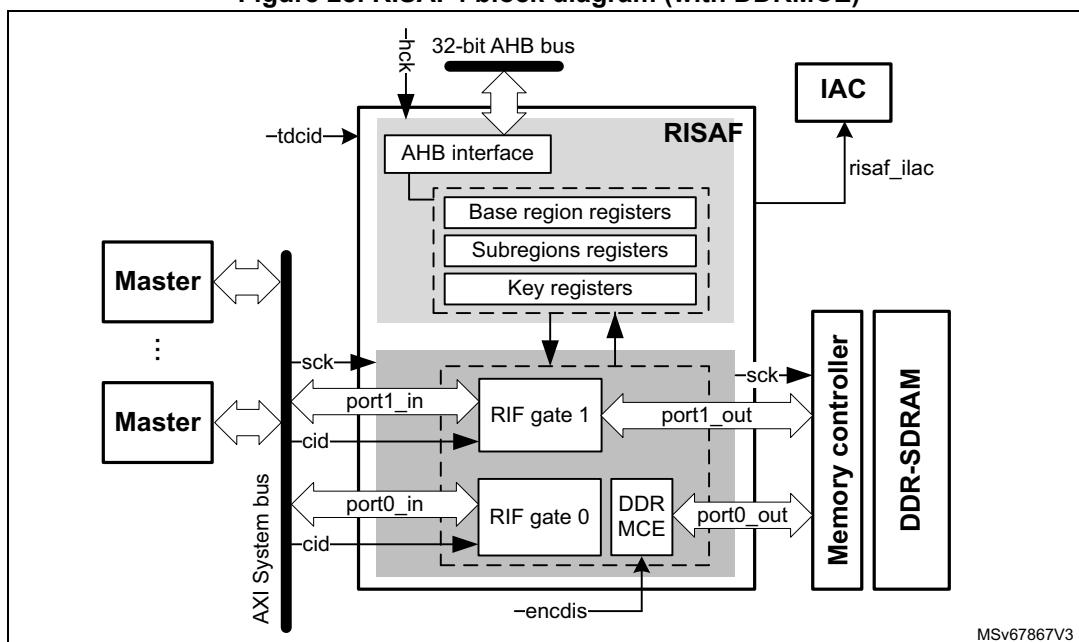
The following figures show the block diagrams of the two RISAF types (single port or dual port with encryption) associated with the IAC, and optionally, a memory controller. Both types are programmed the same way.
Figure 27. RISAF block diagram (without DDRMCE)
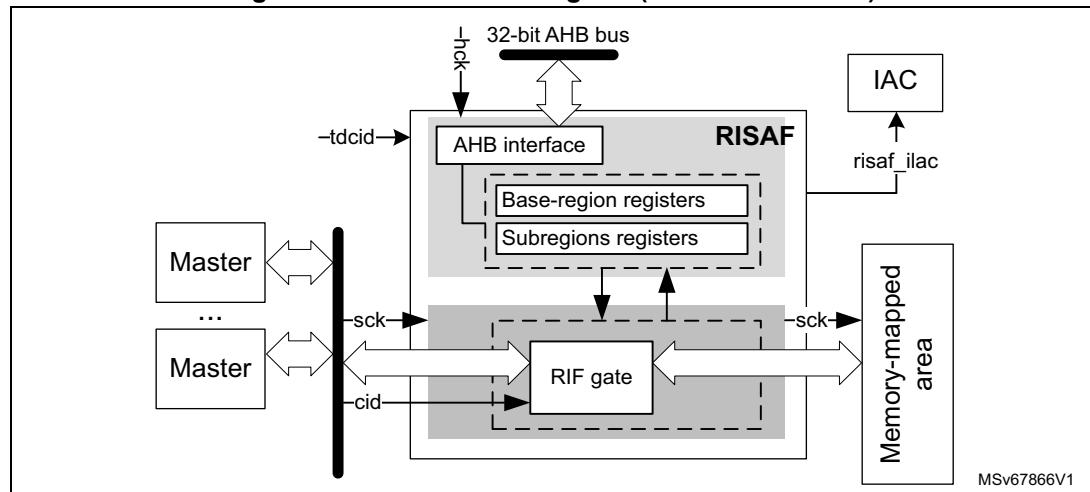
The diagram illustrates the RISAF block structure. On the left, multiple 'Master' blocks are connected to a vertical bus. This bus has three control inputs: \(\overline{tdcid}\), \(\overline{cid}\), and \(\overline{sck}\). The \(\overline{tdcid}\) input is also connected to the 'IAC' block. The RISAF block itself contains an 'AHB interface' which is connected to a '32-bit AHB bus' at the top. Below the AHB interface are 'Base-region registers' and 'Subregions registers'. These registers are connected to a 'RIF gate' at the bottom. The 'RIF gate' has bidirectional data paths (labeled \(\overline{sck}\)) to a 'Memory-mapped area' on the right. The 'IAC' block is connected to the RISAF block via a signal labeled 'risaf_ilac'. The diagram is labeled 'MSv67866V1' in the bottom right corner.
- 1. The \(\overline{tdcid}\) input value is equal to TDCID.
10.4.2 RISAF internal signals
Table 48 describes internal signals available at RISAF level, not at product level (on pins).
Table 48. RISAF internal input/output signals| Name | Type | Description |
|---|---|---|
| risaf_sck | Digital input | System bus clock, also used by the protected memory controller |
| risaf_hclk | AHB bus clock | |
| risaf_ilac | Digital output | Illegal access signal to IAC |
| risaf_encdis | Digital input | Static control signal disabling encryption |
10.4.3 RISAF reset and clocks
The RISAF peripheral has two clocks, one for its AHB register interface, and one for its system bus interfaces. The system bus clock is shared with the system bus memory controller target.
The RISAF peripheral has a single reset input.
Address spaces protected by the RISAF are by default secure, privileged, and TDCID only.
10.4.4 RISAF address space management
Through RISAF registers, a trusted domain application, or the application to whom the configuration has been delegated, assigns memory regions to one or more security domains (secure, privilege, compartment ID). Figure 29 illustrates the principle of this allocation.
Figure 29. RISAF region programming
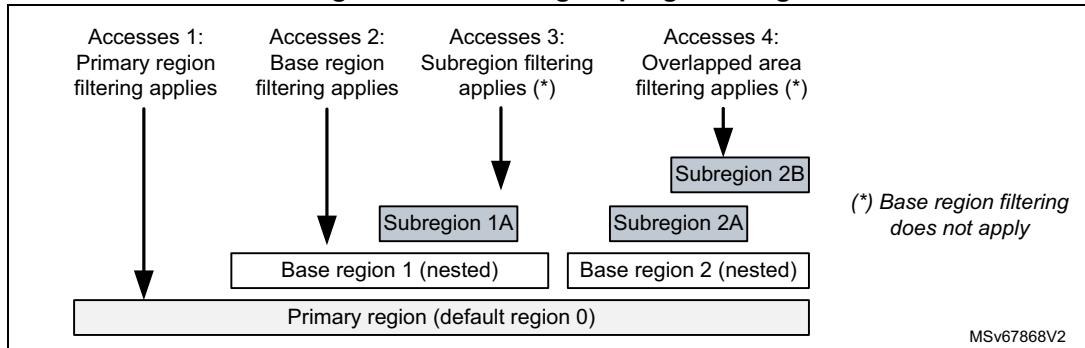
The diagram illustrates the RISAF region programming structure. It shows four access types and their corresponding regions:
- Accesses 1: Primary region filtering applies points to a box labeled Primary region (default region 0).
- Accesses 2: Base region filtering applies points to a box labeled Base region 1 (nested).
- Accesses 3: Subregion filtering applies (*) points to a box labeled Subregion 1A, which is nested within Base region 1 (nested).
- Accesses 4: Overlapped area filtering applies (*) points to a box labeled Subregion 2B, which overlaps with Subregion 2A (nested within Base region 2 (nested)).
A note on the right states: (*) Base region filtering does not apply. The reference code MSv67868V2 is located in the bottom right corner of the diagram area.
As shown in Figure 29, there are multiple types of access filtered by RISAF:
- • Accesses 1 - Default region: access to an area not belonging to any enabled base region. Filtering for such access is fixed to secure, privileged and TDCID only.
- • Accesses 2 - Application region > 0: access to an area in an enabled base region, not belonging to any enabled subregion. Filtering for such access is defined in the base region, where one or more compartments can be granted specific accesses.
- • Accesses 3 - Non overlapped subregion: access to an area in an enabled nested subregion. Filtering for such access is defined in the subregion, with only one compartment that can be granted access.
- • Accesses 4 - Overlapped subregion: accesses to an area overlapping two enabled nested subregions. In this case, filtering rules for these subregions are used by the RISAF as follows:
- – If both subregions are secure (resp. nonsecure), the overlap is secure (resp. nonsecure).
- – If a subregion is nonsecure (resp. unprivileged), the overlap is nonsecure (resp. unprivileged).
- – If a subregion grants access to a compartment, the access can go through. Up to two compartments can be granted access to an overlapped subregion.
Note: When a base or subregion is disabled, the associated filtering is disabled as well. For access types 3 or 4 (detailed above), base region filtering rules do not apply. When two enabled regions overlap, if one region grants access, the access goes through.
As defined in Section 5.4: Resource isolation framework (RIF), a debug domain (privileged) must be granted the following accesses, depending on its security:
- • The secure debug domain can read and write anywhere in the address space protected by RISAF. It can also modify the registers reserved to the trusted domain.
- • For reads (resp. writes), the nonsecure debug domain can only access regions that are tagged by an application as nonsecure, readable (resp. writable) by at least one compartment.
Access rules to secure, nonsecure, privileged, and unprivileged memory regions are described in Section 5.4: Resource isolation framework (RIF).
10.4.5 RISAF programming
Only the trusted domain can set up the access configuration to base region x through RISAF_REGx_CFGR, RISAF_REGx_CIDCFGR, RISAF_REGx_STARTR, and RISAF_REGx_ENDR.
The trusted domain, or the application to which the subregion z configuration has been delegated in RISAF_REGx_zNESTR, can set up the access configuration to subregion z of base region x through RISAF_REGx_zCFGR, RISAF_REGx_zSTARTR, and RISAF_REGx_zENDR (z = A or B).
As shown in Table 49, subregion right options depend upon the base region privileged and security rights.
Table 49. RISAF subregion security setup matrix
| Base region rights | Nested subregion rights | |||
|---|---|---|---|---|
| Secure, privileged | Secure, unprivileged | Nonsecure, privileged | Nonsecure, unprivileged | |
| Secure, privileged | OK(1) | OK | OK | OK |
| Secure, unprivileged | Not allowed | OK(1) | Not allowed | OK |
| Nonsecure, privileged | Not allowed | Not allowed | OK(1) | OK |
| Nonsecure, unprivileged | Not allowed | Not allowed | Not allowed | OK(1) |
1. Default configuration
Configuring base regions in RISAF
The number of regions, the region watermark granularity, and the address space size depend upon the RISAF instance (see Section 10.3).
If the trusted domain must use a base region x (for example at boot time), the following steps are recommended.
- 1. The trusted domain sets start and end addresses for each of the required base region x, using RISAF_REGx_STARTR and RISAF_REGx_ENDR:
- – These registers are initialized with 32-bit physical addresses when the protected address space size is 4 Gbytes. For different sizes, refer to the register description.
- – Base regions must be defined within their primary region. The hardware enforces this rule if the application does not follow it.
- 2. For each of the above region x, the trusted domain programs RISAF_REGx_CIDCFGR, granting read and/or write access to any compartment.
- 3. For each of the above region x, the trusted domain finalizes the programming by configuring RISAF_REGx_CFGR, setting up security parameters (secure or encrypted if applicable), and granting privileged-only access, or not, to each compartment that has access to the region (see step 2).
- 4. After a final check on the above configuration, the trusted domain enables each required base region x, setting the BREN bit in RISAF_REGx_CFGR.
At any time the trusted domain can lock the RISAF configuration until the next reset, by setting the GLOCK bit in RISAF_CR. Subregion registers are the exception to this rule, as explained in Configuring subregions in RISAF.
If the RISAF instance supports encryption (see Section 10.3), and if the trusted application requires region x to be encrypted, the recommended steps are:
- • When ENC[1:0] = 0x2, the AES key is used directly without key derivation and is shared with all similarly encrypted regions, hence it is recommended to have all these regions secure.
- • When ENC[1:0] = 0x1 side-channel protection is activated, impacting performance.
- • When ENCDIS = 1 in RISAF_SR, or when the AXI port that receives the transaction does not support encryption (see port 1 in Figure 28), all writes to this base region x are ignored and all read requests return 0 if ENC[1:0] = 0x1 or 0x2 and BREN is set in RISAF_REGx_CFGR.
Configuring subregions in RISAF
Note: The number of subregions, the subregion watermark granularity, and the primary region address space size depend on the RISAF resource described in Section 10.3.
When an application needs to use the subregion z defined in the base region x, there are two configuration options in RISAF_REGx_zNESTR:
- • The trusted domain programs the RIF configuration for this subregion. In this case DCEN is cleared.
- • The secure privileged software delegates the RIF configuration to a single CID, defined with DCCID. In this case DCEN must also be set.
Configuring a subregion z consists in the following steps.
- 1. Define the start and end address of the subregion using RISAF_REGx_zSTARTR and RISAF_REGx_zENDR registers.
- – When programming subregion watermarks, use similar rules as for base regions (see Configuring base regions in RISAF).
- – Subregions must be defined within their base region. The RISAF enforces this rule if the application does not follow it.
- 2. Modify WREN and RDEN in RISAF_REGx_zCFGR to modify the access right of allowed compartment (defined with SCID bits).
- 3. In the same registers, modify the security and privileged access rights for the allowed compartment, if needed (see Table 49 for applicable restrictions).
- 4. After a final check on the above configuration, the subregion must be enabled by setting SREN bit in RISAF_REGx_zCFGR.
After a trusted domain has locked all base regions (using GLOCK bit), subregion owners can lock their configuration using the RLOCK bit in RISAF_REGx_zCFGR.
Note: Only a secure application can change SEC in RISAF_REGx_zCFGR. If the base region is secure, only a secure application can configure subregion registers.
The overall RISAF initialization is summarized in Figure 30.
Figure 30. RISAF initialization principle
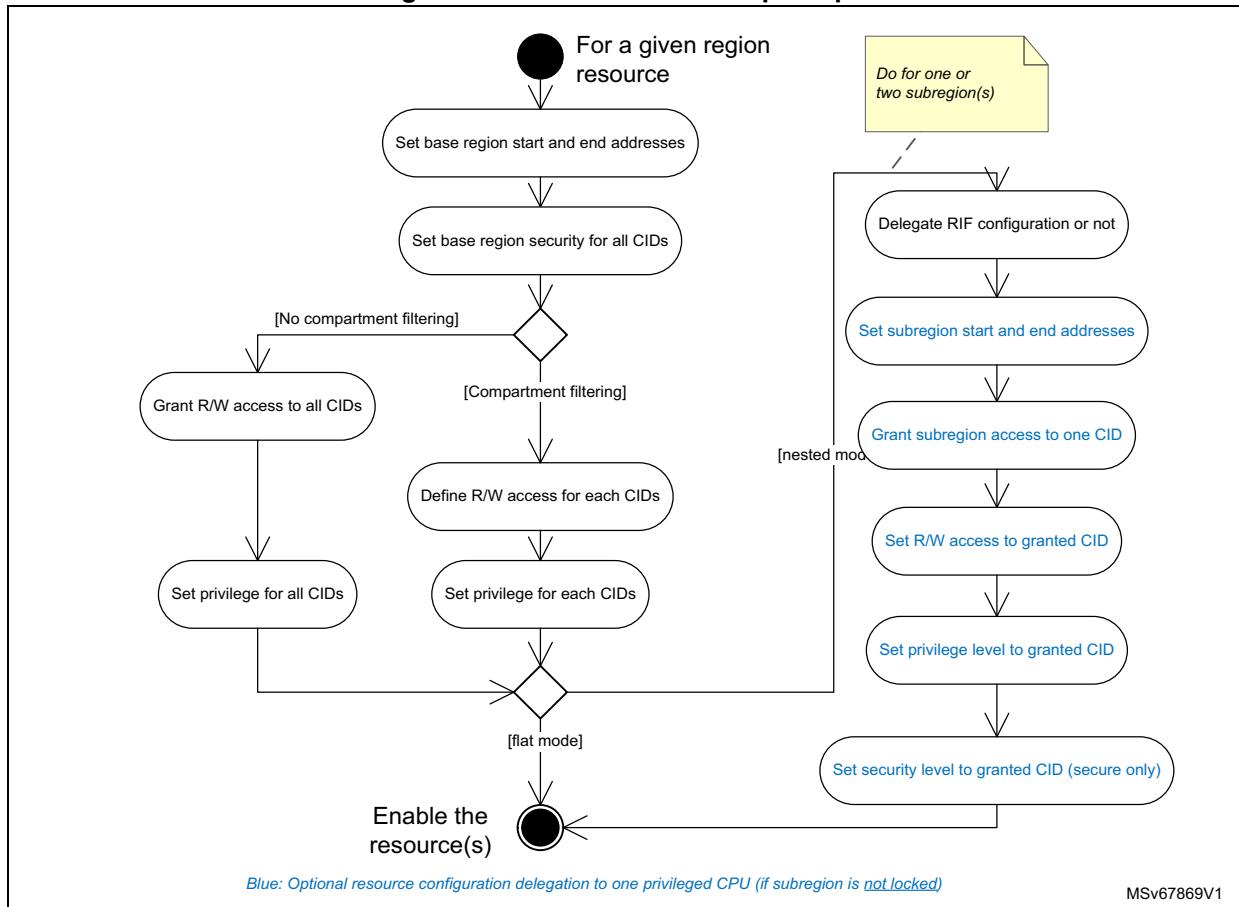
graph TD
    Start((For a given region resource)) --> SetBaseAddr([Set base region start and end addresses])
    SetBaseAddr --> SetBaseSec([Set base region security for all CIDs])
    SetBaseSec --> Decision1{ }
    Decision1 -- "[No compartment filtering]" --> GrantAllR/W([Grant R/W access to all CIDs])
    GrantAllR/W --> SetAllPriv([Set privilege for all CIDs])
    Decision1 -- "[Compartment filtering]" --> DefineEachR/W([Define R/W access for each CIDs])
    DefineEachR/W --> SetEachPriv([Set privilege for each CIDs])
    SetAllPriv --> Decision2{ }
    SetEachPriv --> Decision2
    Decision2 -- "[flat mode]" --> EnableRes((Enable the resource(s)))

    Note[Do for one or two subregion(s)] -.-> DelegateRIF([Delegate RIF configuration or not])
    DelegateRIF --> SetSubAddr([Set subregion start and end addresses])
    SetSubAddr --> GrantSubAccess([Grant subregion access to one CID])
    GrantSubAccess --> SetSubR/W([Set R/W access to granted CID])
    SetSubR/W --> SetSubPriv([Set privilege level to granted CID])
    SetSubPriv --> SetSubSec([Set security level to granted CID secure only])
    SetSubSec --> EnableRes

    NoteText[Blue: Optional resource configuration delegation to one privileged CPU if subregion is not locked]
Blue: Optional resource configuration delegation to one privileged CPU (if subregion is not locked)
MSv67869V1
10.4.6 RISAF runtime modification of region or subregion configuration
The RISAF supports the on-the-fly update of the base region and subregion programming, except for the start- and end-address boundaries:
- • To change RISAF_REGx_STARTR and RISAF_REGx_ENDR, the base region must be disabled (BREN = 0). In this case, the default primary region access rules apply immediately (secure, privileged, TDCID only).
- • To change RISAF_REGx_zSTARTR and RISAF_REGx_zENDR (z = A or B), the subregion must be disabled (SREN = 0). In this case, the base region access rules apply immediately.
If the first solution introduces too many constraints, a workaround is shown in Figure 31.
Figure 31. RISAF region on-the-fly resizing
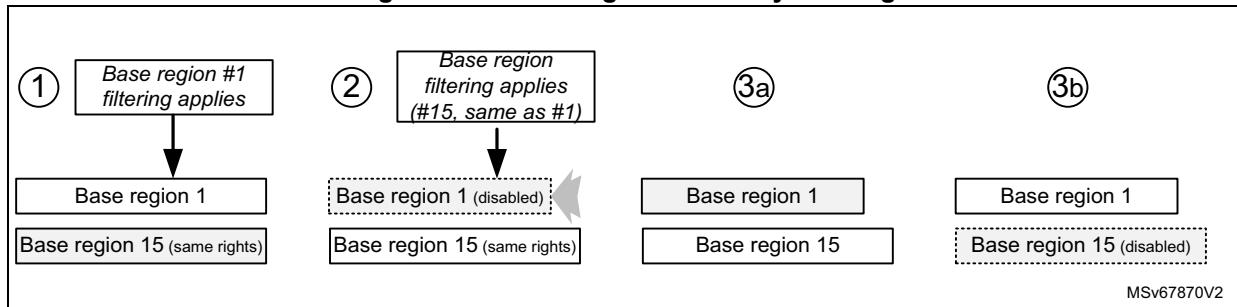
The diagram illustrates the process of resizing a base region on-the-fly. It consists of four stages labeled 1, 2, 3a, and 3b. In stage 1, 'Base region #1 filtering applies' to 'Base region 1' and 'Base region 15 (same rights)'. In stage 2, 'Base region filtering applies (#15, same as #1)' to 'Base region 15 (same rights)' and 'Base region 1 (disabled)'. In stage 3a, 'Base region 1' is enabled and 'Base region 15' is disabled. In stage 3b, 'Base region 1' is enabled and 'Base region 15 (disabled)' is disabled. A reference code 'MSv67870V2' is located in the bottom right corner of the diagram area.
The recommended on-the-fly resizing of base region 1 becomes:
- 1. Define a spare base region (for example 15), exactly as current region 1.
- 2. Disable region 1 by clearing BREN. The region 15 access control (identical to region 1) immediately applies. No effect is experienced at system level. The region 1 can be safely resized.
- 3. Enable region 1, then disable region 15. The new region 1 access control immediately applies. Optionally, subregions can be added on top.
10.4.7 Managing illegal accesses
As a RIF component, the RISAF does not use the standard interrupt lines toward NVIC or GIC concentrators. The IAC captures all RIF interrupt events, called illegal access events.
Refer to Section 11: Illegal access controller (IAC) for more information on how illegal accesses are managed.
10.5 RISAF registers
The registers are accessible through the interface of the RISAF. Only word (32-bit) accesses are supported.
If the debug domain feature is activated and security and privileged policy allows it, the debug domain traffic goes through, regardless of any CID filtering policy. If the debug domain feature is de-activated the CID filtering policy also applies to debug domain traffic.
10.5.1 RISAF configuration register (RISAF_CR)
Address offset: 0x000
Reset value: 0x0000 0000
Secure, privileged, trusted domain TDCID, write access only. Any read access is allowed, writes are ignored if GLOCK is set.
| 31 | 30 | 29 | 28 | 27 | 26 | 25 | 24 | 23 | 22 | 21 | 20 | 19 | 18 | 17 | 16 |
| Res. | Res. | Res. | Res. | Res. | Res. | Res. | Res. | Res. | Res. | Res. | Res. | Res. | Res. | Res. | Res. |
| 15 | 14 | 13 | 12 | 11 | 10 | 9 | 8 | 7 | 6 | 5 | 4 | 3 | 2 | 1 | 0 |
| Res. | Res. | Res. | Res. | Res. | Res. | Res. | Res. | Res. | Res. | Res. | Res. | Res. | Res. | Res. | GLOCK |
| rs |
Bits 31:1 Reserved, must be kept at reset value.
Bit 0 GLOCK: Global lock
This bit locks the configuration of RISAF registers until next reset. It is cleared by default, and, once set, cannot be reset until global RISAF reset.
0: RISAF registers are writable.
1: All writes to RISAF registers are ignored, except RISAF_IACR, RISAF_REGx_zCFGR, RISAF_REGx_zSTARTR, and RISAF_REGx_zENDR (z = A to B).
10.5.2 RISAF status register (RISAF_SR)
Address offset: 0x004
Reset value: 0x0000 0000
Secure, privileged, trusted domain TDCID, read access only.
| 31 | 30 | 29 | 28 | 27 | 26 | 25 | 24 | 23 | 22 | 21 | 20 | 19 | 18 | 17 | 16 |
| Res. | Res. | Res. | Res. | Res. | Res. | Res. | Res. | Res. | Res. | Res. | Res. | Res. | Res. | Res. | Res. |
| 15 | 14 | 13 | 12 | 11 | 10 | 9 | 8 | 7 | 6 | 5 | 4 | 3 | 2 | 1 | 0 |
| Res. | Res. | Res. | Res. | Res. | Res. | Res. | Res. | Res. | Res. | Res. | Res. | Res. | ENC DIS | KEY RDY | KEY VALID |
| r | r | r |
Bits 31:3 Reserved, must be kept at reset value.
Bit 2 ENCDIS: Encryption disabled
This bit is reserved if the encryption feature is not available in RISAF (see Section 10.3). It is a non-volatile product configuration that cannot be changed by software.
0: When ENC[1:0] = 0x1 or 0x2 and BREN is set in RISAF_REGx_CFGR, all allowed write accesses in region x are encrypted, and all allowed read requests are decrypted.
1: When ENC[1:0] = 0x1 or 0x2 and BREN is set in RISAF_REGx_CFGR, all write accesses in region x are ignored, and all read requests return 0. In other words, the AES feature of RISAF is unusable, for any region.
Note: If BREN = 0, the AES feature of RISAF is not usable for a given region.
Bit 1 KEYRDY: Key ready
This bit is reserved if the encryption feature is not available in RISAF (see Section 10.3).
0: The most recently written key in RISAF_KEYRy is being expanded
1: The most recently written key in RISAF_KEYRy is ready for use
Bit 0 KEYVALID: Key valid
This bit is reserved if the encryption feature is not available in RISAF (see Section 10.3).
0: A valid key has not been written in RISAF_KEYRy
1: A valid key has been written in RISAF_KEYRy
10.5.3 RISAF illegal access status register (RISAF_IASR)
Address offset: 0x008
Reset value: 0x0000 0000
Secure, privileged, trusted domain TDCID, read access only.
| 31 | 30 | 29 | 28 | 27 | 26 | 25 | 24 | 23 | 22 | 21 | 20 | 19 | 18 | 17 | 16 |
|---|---|---|---|---|---|---|---|---|---|---|---|---|---|---|---|
| Res. | Res. | Res. | Res. | Res. | Res. | Res. | Res. | Res. | Res. | Res. | Res. | Res. | Res. | Res. | Res. |
| 15 | 14 | 13 | 12 | 11 | 10 | 9 | 8 | 7 | 6 | 5 | 4 | 3 | 2 | 1 | 0 |
| Res. | Res. | Res. | Res. | Res. | Res. | Res. | Res. | Res. | Res. | Res. | Res. | Res. | IAEF1 | IAEF0 | CAEF |
| r | r | r |
Bits 31:3 Reserved, must be kept at reset value.
Bit 2 IAEF1: Illegal access error flag 1
This bit is reserved if the dual port feature is not available in the RISAF instance (see Section 10.3). The bit is set when an illegal access is detected by checker unit 1 on the system bus. More details on the error can be found in RISAF_IAESR1 and RISAF_IADDR1. This bit is cleared by setting the corresponding bit in RISAF_IACR.
Bit 1 IAEF0: Illegal access error flag 0
This bit is set when an illegal access is detected by checker unit 0 on the system bus. More details on the error can be found in RISAF_IAESR0 and RISAF_IADDR0. This bit is cleared by setting corresponding bit in RISAF_IACR.
Bit 0 CAEF: Configuration access error flag
This bit is set when an illegal access to any RISAF configuration register is detected. It is cleared by setting the corresponding bit in RISAF_IACR.
10.5.4 RISAF illegal access clear register (RISAF_IACR)
Address offset: 0x00C
Reset value: 0x0000 0000
Secure, privileged, trusted domain TDCID, write access only.
| 31 | 30 | 29 | 28 | 27 | 26 | 25 | 24 | 23 | 22 | 21 | 20 | 19 | 18 | 17 | 16 |
| Res. | Res. | Res. | Res. | Res. | Res. | Res. | Res. | Res. | Res. | Res. | Res. | Res. | Res. | Res. | Res. |
| 15 | 14 | 13 | 12 | 11 | 10 | 9 | 8 | 7 | 6 | 5 | 4 | 3 | 2 | 1 | 0 |
| Res. | Res. | Res. | Res. | Res. | Res. | Res. | Res. | Res. | Res. | Res. | Res. | Res. | IAEF1 | IAEF0 | CAEF |
| w | w | w |
Bits 31:3 Reserved, must be kept at reset value.
Bit 2 IAEF1: Illegal access error flag 1
This bit is reserved if the dual port feature is not available in the RISAF instance (see Section 10.3). Set this bit to clear IAEF1 in RISAF_IASR, allowing the capture of a new error information from RIF gate 1 in RISAF_IAESR1 and RISAF_IADDR1.
Note: Clearing this bit does not clear RISAF_IADDR1.
Bit 1 IAEF0: Illegal access error flag 0
Set this bit to clear IAEF0 in RISAF_IASR, allowing the capture of a new error information from RIF gate 0 in RISAF_IAESR0 and RISAF_IADDR0 registers.
Note: Clearing this bit does not clear RISAF_IADDR0.
Bit 0 CAEF: Configuration access error flag
Set this bit to clear CAEF in RISAF_IASR.
10.5.5 RISAF illegal access error status register x (RISAF_IAESRx)
Address offset: 0x020 + 0x8 * x (x = 0 to 1)
Reset value: 0x0000 0000
Secure, privileged, trusted domain TDCID, read access only.
Note: RISAF_IAESR1 is reserved if the dual port feature is not available in the RISAF instance (see Section 10.3).
| 31 | 30 | 29 | 28 | 27 | 26 | 25 | 24 | 23 | 22 | 21 | 20 | 19 | 18 | 17 | 16 |
| Res. | Res. | Res. | Res. | Res. | Res. | Res. | Res. | Res. | Res. | Res. | Res. | Res. | Res. | Res. | Res. |
| 15 | 14 | 13 | 12 | 11 | 10 | 9 | 8 | 7 | 6 | 5 | 4 | 3 | 2 | 1 | 0 |
| Res. | Res. | Res. | Res. | Res. | Res. | Res. | Res. | IANRW | Res. | IASEC | IAPRIV | Res. | IACID[2:0] | ||
| r | r | r | r | r | r | ||||||||||
Bits 31:8 Reserved, must be kept at reset value.
Bit 7 IANRW: Illegal access read/write
When IAEFx = 1 in RISAF_IASR, IANRW captures the access type of the illegal access that has been detected by RIF gate x.
- 0: Illegal access was a data read or an instruction fetch
- 1: Illegal access was a data write
Bit 6 Reserved, must be kept at reset value.
Bit 5 IASEC: Illegal access security
When IAEFx = 1 in RISAF_IASR, IASEC captures the security type of the illegal access that has been detected by RIF gate x.
- 0: Illegal access was nonsecure
- 1: Illegal access was secure
Bit 4 IAPRIV: Illegal access privileged
When IAEFx = 1 in RISAF_IASR, IAPRIV captures the privilege state of the master that issued the illegal access detected by RIF gate x.
- 0: Illegal access was unprivileged
- 1: Illegal access was privileged
Bit 3 Reserved, must be kept at reset value.
Bits 2:0 IACID[2:0]: Illegal access compartment ID
When IAEFx = 1 in RISAF_IASR, IACID[2:0] captures the compartment ID of the master that issued the illegal access detected.
10.5.6 RISAF illegal address register x (RISAF_IADDRx)
Address offset: 0x024+0x8*x (x = 0 to 1)
Reset value: 0x0000 0000
Secure, privileged, trusted domain TDCID, read access only.
Note: RISAF_IADDR1 is reserved if the dual port feature is not available in the RISAF instance (see Section 10.3).
| 31 | 30 | 29 | 28 | 27 | 26 | 25 | 24 | 23 | 22 | 21 | 20 | 19 | 18 | 17 | 16 |
| IADD[31:16] | |||||||||||||||
| r | r | r | r | r | r | r | r | r | r | r | r | r | r | r | r |
| 15 | 14 | 13 | 12 | 11 | 10 | 9 | 8 | 7 | 6 | 5 | 4 | 3 | 2 | 1 | 0 |
| IADD[15:0] | |||||||||||||||
| r | r | r | r | r | r | r | r | r | r | r | r | r | r | r | r |
Bits 31:0 IADD[31:0]: Illegal address
When IAEFx = 1 in RISAF_IASR, IADD[31:0] captures the address of the erroneous access through RIF gate x. Additional information can be found in RISAF_IAESRx. Captured address information is the byte offset from the base of the protected address space.
10.5.7 RISAF encryption key y (RISAF_KEYRy)
Address offset: 0x030+0x4*y (y = 0 to 3)
Reset value: 0x0000 0000
Secure, privileged, trusted domain TDCID, write access only. Writes are ignored if GLOCK is set in RISAF_CR.
Note: RISAF_KEYR0/1/2/3 are reserved if the DDRMCE feature is not available in the RISAF instance (see Section 10.3).
| 31 | 30 | 29 | 28 | 27 | 26 | 25 | 24 | 23 | 22 | 21 | 20 | 19 | 18 | 17 | 16 |
| KEY{i + 32 * y} | |||||||||||||||
| w | w | w | w | w | w | w | w | w | w | w | w | w | w | w | w |
| 15 | 14 | 13 | 12 | 11 | 10 | 9 | 8 | 7 | 6 | 5 | 4 | 3 | 2 | 1 | 0 |
| KEY{i + 32 * y} | |||||||||||||||
| w | w | w | w | w | w | w | w | w | w | w | w | w | w | w | w |
Bits 31:0 KEY{i + 32 * y}: Cryptographic key (i = 31 to 0)
Write any value to this register to initialize this part of the key used by the DDRMCE when ENC[1:0]= 0x2.
The four key registers must be written in ascending order (KEYR0 to KEYR3) to set the KEYVALID bit. If this bit is not set after successful writing to those four registers, BSEC peripheral must be reset.
10.5.8 RISAF region x configuration register (RISAF_REGx_CFGR)
Address offset: 0x040 + 0x40 * (x - 1) (x = 1 to 15)
Reset value: 0x0000 0000
Secure, privileged, trusted domain TDCID, write access only. Any read access is allowed on this register. Writes are ignored if GLOCK is set in RISAF_CR.
Refer to Section 10.3 to verify the number of base regions supported by this RISAF instance.
| 31 | 30 | 29 | 28 | 27 | 26 | 25 | 24 | 23 | 22 | 21 | 20 | 19 | 18 | 17 | 16 |
| Res. | Res. | Res. | Res. | Res. | Res. | Res. | Res. | PRIV C7 | PRIV C6 | PRIV C5 | PRIV C4 | PRIV C3 | PRIV C2 | PRIV C1 | PRIV C0 |
| rw | rw | rw | rw | rw | rw | rw | rw | ||||||||
| 15 | 14 | 13 | 12 | 11 | 10 | 9 | 8 | 7 | 6 | 5 | 4 | 3 | 2 | 1 | 0 |
| ENC[1:0] | Res. | Res. | Res. | Res. | Res. | SEC | Res. | Res. | Res. | Res. | Res. | Res. | Res. | BREN | |
| rw | rw | rw | rw | ||||||||||||
Bits 31:24 Reserved, must be kept at reset value.
Bits 23:16 PRIVCy: Privileged access for compartment y (y = 7 to 0)
This bit is taken into account only if BREN = 1.
0: Application running in compartment y can access to region x in privileged and unprivileged mode.
1: Application running in compartment y can access to region x in privileged mode only.
Bits 15:14 ENC[1:0]: Encrypted region
This bitfield is taken into account only if BREN = 1 and if the DDRMCE feature is available in RISAF (see ENCDIS in RISAF_SR and Section 10.3).
0x0: No effect
0x1: Block cipher. All allowed write accesses are encrypted, all allowed read requests are decrypted. In this mode special side-channel protection is activated, with impacting performance.
0x2: Fast block cipher. All allowed write accesses are encrypted, all allowed read requests are decrypted, when KEYRDY is set in RISAF_SR (to be used for secure regions only).
0x3: No effect
As the AES key is computed using the physical address information, ENC[1:0] = 0x1 must not be used only for secure regions. Key registers RISAF_KEYRy must be properly initialized before writing 0x2 to ENC[1:0] (KEYVALID set in RISAF_SR). Similarly, key registers RISAF_MKEYRy must be properly initialized before writing 0x1 to ENC[1:0] (MKVALID set in RISAF_XSR).
Bits 13:9 Reserved, must be kept at reset value.
Bit 8 SEC: Secure region
This bit is taken into account only if BREN = 1.
0: Only nonsecure requests can access region x. SEC value in RISAF_REGx_zCFGR is internally treated as 0-ed by RISAF (only nonsecure requests to subregions).
1: Only secure requests can access region x, and optional subregions can be defined as secure or nonsecure.
Bits 7:1 Reserved, must be kept at reset value.
Bit 0 BREN: Base region enable
0: Base region x is disabled. Access control of primary region 0 (secure, privileged, trusted domain TDCID) applies to any access between region x start and end addresses. Associated subregions are also disabled.
1: Base region x is enabled. Access controls defined in region x apply to any access between region x start and end addresses.
Note: The filtering starts from start address RISAF_REGx_STARTR (included) and ends at end address RISAF_REGx_ENDR (included).
10.5.9 RISAF region x start-address register (RISAF_REGx_STARTR)
Address offset: 0x044+0x40*(x-1) (x = 1 to 15)
Reset value: 0x0000 0000
Secure, privileged, trusted domain TDCID, write access only. Any read access is allowed on this register. Writes are ignored if GLOCK is set in RISAF_CR, or if BREN is set in RISAF_REGx_CFGR.
Refer to Section 10.3 to verify the number of base regions supported by this RISAF instance, and for details on protected address space size and watermark granularity.
| 31 | 30 | 29 | 28 | 27 | 26 | 25 | 24 | 23 | 22 | 21 | 20 | 19 | 18 | 17 | 16 |
|---|---|---|---|---|---|---|---|---|---|---|---|---|---|---|---|
| BADDSTART[31:16] | |||||||||||||||
| rw | rw | rw | rw | rw | rw | rw | rw | rw | rw | rw | rw | rw | rw | rw | rw |
| 15 | 14 | 13 | 12 | 11 | 10 | 9 | 8 | 7 | 6 | 5 | 4 | 3 | 2 | 1 | 0 |
| BADDSTART[15:0] | |||||||||||||||
| rw | rw | rw | rw | rw | rw | rw | rw | rw | rw | rw | rw | rw | rw | rw | rw |
Bits 31:0 BADDSTART[31:0]: Base region address start
This bitfield defines the byte-address offset (relative to the base address of the protected address space) of the lowest byte-address in base region x.
Address bits less than the granularity and greater than the protected address space size cannot be written to, and remain 0.
10.5.10 RISAF region x end-address register (RISAF_REGx_ENDR)
Address offset: 0x048+0x40*(x-1) (x = 1 to 15)
Reset value: 0x0000 0FFF
The reset value given here applies when the granularity is 4 Kbytes. If the granularity is 2ⁿ, the reset value is 2ⁿ-1.
Secure, privileged, trusted domain TDCID, write access only. Any read access is allowed on this register. Writes are ignored if GLOCK is set in RISAF_CR, or if BREN is set in RISAF_REGx_CFGR.
Refer to Section 10.3 to verify the number of base regions supported by this RISAF instance, and for details on protected address space size and watermark granularity.
| 31 | 30 | 29 | 28 | 27 | 26 | 25 | 24 | 23 | 22 | 21 | 20 | 19 | 18 | 17 | 16 |
| BADDEND[31:16] | |||||||||||||||
| rw | rw | rw | rw | rw | rw | rw | rw | rw | rw | rw | rw | rw | rw | rw | rw |
| 15 | 14 | 13 | 12 | 11 | 10 | 9 | 8 | 7 | 6 | 5 | 4 | 3 | 2 | 1 | 0 |
| BADDEND[15:0] | |||||||||||||||
| rw | rw | rw | rw | rw | rw | rw | rw | rw | rw | rw | rw | rw | rw | rw | rw |
Bits 31:0 BADDEND[31:0]: Base region address end
This bitfield defines the byte-address offset (relative to the base address of the protected address space) of the highest byte-address in base region x.
Address bits less than the granularity cannot be modified, and remain 1.
Address bits greater than the protected address space size cannot be written, and remain 0.
10.5.11 RISAF region x CID configuration register (RISAF_REGx_CIDCFGR)
Address offset: 0x04C+0x40*(x-1) (x = 1 to 15)
Reset value: 0x0000 0000
Secure, privileged, trusted domain TDCID, write access only. Any read access is allowed on this register. Writes are ignored if GLOCK is set in RISAF_CR.
Refer to Section 10.3 to verify the number of base regions supported by this RISAF instance.
| 31 | 30 | 29 | 28 | 27 | 26 | 25 | 24 | 23 | 22 | 21 | 20 | 19 | 18 | 17 | 16 |
| Res. | Res. | Res. | Res. | Res. | Res. | Res. | Res. | WREN C7 | WREN C6 | WREN C5 | WREN C4 | WREN C3 | WREN C2 | WREN C1 | WREN C0 |
| rw | rw | rw | rw | rw | rw | rw | rw | ||||||||
| 15 | 14 | 13 | 12 | 11 | 10 | 9 | 8 | 7 | 6 | 5 | 4 | 3 | 2 | 1 | 0 |
| Res. | Res. | Res. | Res. | Res. | Res. | Res. | Res. | RDEN C7 | RDEN C6 | RDEN C5 | RDEN C4 | RDEN C3 | RDEN C2 | RDEN C1 | RDEN C0 |
| rw | rw | rw | rw | rw | rw | rw | rw |
Bits 31:24 Reserved, must be kept at reset value.
Bits 23:16 WRENCy: Write enable for compartment y (y = 7 to 0)
This bit is taken into account only if BREN = 1 in RISAF_REGx_CFGR.
0: Application running in compartment y cannot write to region x (write ignored).
1: Application running in compartment y can write to region x. Additional control defined by SEC and PRIVCy in RISAF_REGx_CFGR, also applies.
Bits 15:8 Reserved, must be kept at reset value.
Bits 7:0 RDENCy: Read enable for compartment y (y = 7 to 0)
This bit is taken into account only if BREN = 1 in RISAF_REGx_CFGR.
0: Application running in compartment y cannot read region x (read as 0).
1: Application running in compartment y can read region x. Additional control defined by SEC and PRIVCy in RISAF_REGx_CFGR, also applies.
10.5.12 RISAF region x subregion A configuration register (RISAF_REGx_ACFGR)
Address offset: 0x050+0x40*(x-1) (x = 1 to 15)
Reset value: 0x0000 0000
Unprivileged writes are ignored. Nonsecure writes are ignored if SEC = 1 in RISAF_REGx_CFGR, or if DCEN = 0 in RISAF_REGx_ANESTR. Any read access is allowed to this register. Writes are ignored if RLOCK = 1 in this register.
When the delegated configuration is enabled (DCEN = 1 in RISAF_REGx_ANESTR), only the compartment DCCID defined in RISAF_REGx_ANESTR can write to this register.
When the delegation is disabled (DCEN = 0), only the trusted domain can program this register.
Refer to Section 10.3 to verify the number of base regions and subregions supported by this RISAF instance.
| 31 | 30 | 29 | 28 | 27 | 26 | 25 | 24 | 23 | 22 | 21 | 20 | 19 | 18 | 17 | 16 |
| Res. | Res. | Res. | Res. | Res. | Res. | Res. | Res. | Res. | Res. | Res. | Res. | Res. | Res. | Res. | Res. |
| 15 | 14 | 13 | 12 | 11 | 10 | 9 | 8 | 7 | 6 | 5 | 4 | 3 | 2 | 1 | 0 |
| ENC[1:0] | WREN | RDEN | Res. | Res. | PRIV | SEC | Res. | SRCID[2:0] | Res. | Res. | RLOCK | SREN | |||
| r | r | rw | rw | rw | rw | rw | rw | rs | rw | ||||||
Bits 31:16 Reserved, must be kept at reset value.
Bits 15:14 ENC[1:0]: Encrypted subregion
This read-only bitfield is a mirror to ENC[1:0] in RISAF_REGx_CFGR. It is reserved if the encryption feature is not available in RISAF (see ENCDIS in RISAF_SR, and Section 10.3).
0x0: No effect
0x1, 0x2: Allowed read (write) requests to subregion A of region x are decrypted (encrypted)
0x3: No effect
Bit 13 WREN: Write enable
This bit is taken into account only if SREN = 1 in this register.
0: Any write to subregion A of region x is ignored
1: Subregion A of region x can be written
Bit 12 RDEN: Read enable
This bit is taken into account only if SREN = 1 in this register.
0: Any read to subregion A of region x returns 0
1: Subregion A of region x can be read
Bits 11:10 Reserved, must be kept at reset value.
Bit 9 PRIV: Privileged subregion
This bit is taken into account only if SREN = 1 in this register.
0: Privileged and unprivileged accesses are granted in subregion A of region x
1: Only privileged accesses are granted in subregion A of region x
Note: When base region x is defined as unprivileged for the SCID compartment (PRIVCy = 0 in RISAF_REGx_CFGR, with SRCID = Cy), unprivileged accesses to subregion A are always granted.
Bit 8 SEC: Secure subregion
This bit is taken into account only if SREN = 1 in this register. Nonsecure modification to it are discarded.
0: Only nonsecure requests can access subregion A of region x
1: Only secure requests can access subregion A of region x
Note: When base region x is defined as nonsecure (SEC = 0 in RISAF_REGx_CFGR), only nonsecure accesses to subregion A are granted.
Bit 7 Reserved, must be kept at reset value.
Bits 6:4 SRCID[2:0]: Subregion CID
When SREN = 1 in this register, SRCID[2:0] defines which compartment has access to subregion A of RISAF region x.
Bits 3:2 Reserved, must be kept at reset value.
Bit 1 LOCK: Resource lock
When this bit is set, the subregion resource is locked.
0: RISAF_REGx_ACFGR, RISAF_REGx_ASTARTR, and RISAF_REGx_AENDR are writable
1: Writes to RISAF_REGx_ACFGR, RISAF_REGx_ASTARTR, and RISAF_REGx_AENDR are ignored
Note: This bit is set once, cleared only by RISAF reset. It cannot be set if LOCK = 0 in RISAF_CR.
Bit 0 SREN: Subregion enable
0: Subregion A is disabled. Access control of base region x applies to any access between this subregion start and end addresses.
1: Subregion A of region x is enabled. Access control defined in subregion A applies to any access between subregion A start and end addresses.
Note: The filtering starts from address RISAF_REGx_ASTARTR (included), and ends at address RISAF_REGx_AENDR (included).
10.5.13 RISAF region x subregion A start-address register (RISAF_REGx_ASTARTR)
Address offset: 0x054+0x40*(x-1) (x = 1 to 15)
Reset value: 0x0000 0000
Unprivileged writes are ignored. Nonsecure writes are ignored if SEC = 1 in RISAF_REGx_CFGR, or if DCEN = 0 in RISAF_REGx_ANESTR. Any read access is allowed to this register. Writes are ignored if RLOCK = 1 or SREN = 1 in RISAF_REGx_ACFGR.
When the delegated configuration is enabled (DCEN = 1 in RISAF_REGx_ANESTR), only the compartment DCCID defined in RISAF_REGx_ANESTR can write to this register. When the delegation is disabled (DCEN = 0), only the trusted domain can program this register.
Refer to Section 10.3 to verify the number of base regions and subregions supported by this RISAF instance, and for details on protected address space size and watermark granularity.
| 31 | 30 | 29 | 28 | 27 | 26 | 25 | 24 | 23 | 22 | 21 | 20 | 19 | 18 | 17 | 16 |
| SADDSTART[31:16] | |||||||||||||||
| rw | rw | rw | rw | rw | rw | rw | rw | rw | rw | rw | rw | rw | rw | rw | rw |
| 15 | 14 | 13 | 12 | 11 | 10 | 9 | 8 | 7 | 6 | 5 | 4 | 3 | 2 | 1 | 0 |
| SADDSTART[15:0] | |||||||||||||||
| rw | rw | rw | rw | rw | rw | rw | rw | rw | rw | rw | rw | rw | rw | rw | rw |
Bits 31:0 SADDSTART[31:0]: Subregion address start
This bitfield defines the byte-address offset (relative to the base address of the protected address space) of the lowest byte-address in subregion A in base region x.
Address bits less than the granularity and greater than the protected address space size cannot be written, and remain 0.
The effective subregion is the intersection of the subregion and its base region (there is no point in programming SADDSTART below the associated BADDSTART).
10.5.14 RISAF region x subregion A end-address register (RISAF_REGx_AENDR)
Address offset: 0x058+0x40*(x-1) (x = 1 to 15)
Reset value: 0x0000 0FFF
This reset value applies when the granularity is 4 Kbytes. More in general, if the granularity is 2ⁿ, the reset value is 2ⁿ-1.
Unprivileged writes are ignored. Nonsecure writes are ignored if SEC = 1 in RISAF_REGx_CFGR, or if DCEN = 0 in RISAF_REGx_ANESTR. Any read access is allowed to this register. Writes are ignored if RLOCK = 1 or SREN = 1 in RISAF_REGx_ACFGR.
When the delegated configuration is enabled (DCEN = 1 in RISAF_REGx_ANESTR), only the compartment DCCID defined in RISAF_REGx_ANESTR can write to this register. When the delegation is disabled (DCEN = 0), only the trusted domain can program this register.
Refer to Section 10.3 to verify the number of base regions and subregions supported by this RISAF instance, and for details on protected address space size and watermark granularity.
| 31 | 30 | 29 | 28 | 27 | 26 | 25 | 24 | 23 | 22 | 21 | 20 | 19 | 18 | 17 | 16 |
| SADDEND[31:16] | |||||||||||||||
| rw | rw | rw | rw | rw | rw | rw | rw | rw | rw | rw | rw | rw | rw | rw | rw |
| 15 | 14 | 13 | 12 | 11 | 10 | 9 | 8 | 7 | 6 | 5 | 4 | 3 | 2 | 1 | 0 |
| SADDEND[15:0] | |||||||||||||||
| rw | rw | rw | rw | rw | rw | rw | rw | rw | rw | rw | rw | rw | rw | rw | rw |
Bits 31:0 SADDEND[31:0]: Subregion address end
This bitfield defines the byte-address offset (relative to the base address of the protected address space) of the highest byte-address of subregion A in base region x.
Address bits less than the granularity cannot be modified, and remain 1.
Address bits greater than the protected address space size cannot be written, and remain 0.
The effective subregion is the intersection of the subregion and its base region (there is no point in programming SADDEND higher than the associated BADDEND).
10.5.15 RISAF region x subregion A nested mode register (RISAF_REGx_ANESTR)
Address offset: 0x05C+0x40*(x-1) (x = 1 to 15)
Reset value: 0x0000 0000
Secure, privileged, trusted domain TDCID, write access only. Any read access is allowed on this register. Writes are ignored if GLOCK is set in RISAF_CR.
Refer to Section 10.3 to verify the number of base regions and subregions supported by this RISAF instance.
| 31 | 30 | 29 | 28 | 27 | 26 | 25 | 24 | 23 | 22 | 21 | 20 | 19 | 18 | 17 | 16 |
| Res. | Res. | Res. | Res. | Res. | Res. | Res. | Res. | Res. | Res. | Res. | Res. | Res. | Res. | Res. | Res. |
| 15 | 14 | 13 | 12 | 11 | 10 | 9 | 8 | 7 | 6 | 5 | 4 | 3 | 2 | 1 | 0 |
| Res. | Res. | Res. | Res. | Res. | Res. | Res. | Res. | Res. | DCCID[2:0] | Res. | DCEN | Res. | Res. | ||
| rw | rw | rw | rw | ||||||||||||
Bits 31:7 Reserved, must be kept at reset value.
Bits 6:4 DCCID[2:0]: Delegated configuration CID
The trusted domain can use this bitfield to statically define which compartment can program the RIF configuration of subregion A if DCEN = 1 in this register.
Bit 3 Reserved, must be kept at reset value.
Bit 2 DCEN: Delegated configuration enable
0: RIF configuration for subregion A can be written only by the trusted domain.
1: RIF configuration for subregion A can be written only by compartment DCCID, defined in this register. If base region x is defined as secure (SEC = 1), nonsecure write accesses to this subregion RIF configuration by compartment DCCID are ignored.
Note: RIF configuration of subregion A is defined as RISAF_REGx_ACFGR, RISAF_REGx_ASTARTR, and RISAF_REGx_AENDR.
Bits 1:0 Reserved, must be kept at reset value.
10.5.16 RISAF region x subregion B configuration register (RISAF_REGx_BCFGR)
Address offset: 0x060 + 0x40 * (x - 1) (x = 1 to 15)
Reset value: 0x0000 0000
Unprivileged writes are ignored. Nonsecure writes are ignored if SEC = 1 in RISAF_REGx_CFGR, or if DCEN = 0 in RISAF_REGx_BNESTR. Any read access is allowed to this register. Writes are ignored if RLOCK = 1 or SREN = 1 in RISAF_REGx_BCFGR.
When the delegated configuration is enabled (DCEN = 1 in RISAF_REGx_BNESTR), only the compartment DCCID defined in RISAF_REGx_BNESTR can write to this register. When the delegation is disabled (DCEN = 0), only the trusted domain can program this register.
Refer to Section 10.3 to verify the number of base regions and subregions supported by this RISAF instance.
| column_1 | column_2 | Bit 2 | DCEN Refer to | column_5 | Section 10.3 | column_7 | column_8 | column_9 | column_10 | column_11 | column_12 | column_13 | column_14 | column_15 | column_16 | column_17 | RM0506 |
|---|---|---|---|---|---|---|---|---|---|---|---|---|---|---|---|---|---|
| 31 | 30 | 29 | 28 | 27 | 26 | 25 | 24 | 23 | 22 | 21 | 20 | 19 18 | 17 16 | ||||
| Res. | Res. | Res. | Res. | Res. | Res. | Res. | Res. | Res. | Res. | Res. | Res. | Res. Res. | Res. Res. | ||||
| 15 | 14 | 13 | 12 | 11 | 10 | 9 | 8 | 7 | 6 | 5 | 4 | 3 2 | 1 0 | ||||
| ENC[1:0] | WREN RDEN | Res. | Res. | PRIV | SEC | Res. | SRCID[2:0] | Res. Res. | RLOCK SREN | ||||||||
| r | r | rw | rw | rw | rw | rw | rw | rw | rs rw | ||||||||
| Bits 15:14 | ENC[1:0] | : Encrypted subregion | |||||||||||||||
| encryption feature is not available in RISAF (see ENCDIS in RISAF_SR, and | Section 10.3 ). | ||||||||||||||||
| Bit 13 | WREN | : Write enable | |||||||||||||||
| Bit 12 | RDEN | : Read enable |
Bits 31:16 Reserved, must be kept at reset value.
Bits 15:14 ENC[1:0]: Encrypted subregion
This read-only bitfield is a mirror to ENC[1:0] in RISAF_REGx_CFGR. It is reserved if the encryption feature is not available in RISAF (see ENCDIS in RISAF_SR, and Section 10.3).
0x0: No effect
0x1, 0x2: Allowed read (write) requests to subregion B of region x are decrypted (encrypted)
0x3: No effect
Bit 13 WREN: Write enable
This bit is taken into account only if SREN = 1 in this register.
0: Any write to subregion B of region x is ignored
1: Subregion B of region x can be written
Bit 12 RDEN: Read enable
This bit is taken into account only if SREN = 1 in this register.
0: Any read to subregion B of region x returns 0
1: Subregion B of region x can be read
Bits 11:10 Reserved, must be kept at reset value.
Bit 9 PRIV: Privileged subregion
This bit is taken into account only if SREN = 1 in this register.
0: Privileged and unprivileged accesses are granted in subregion B of region x
1: Only privileged accesses are granted in subregion B of region x
Note: When base region x is defined as unprivileged for the SCID compartment (PRIVCy = 0 in RISAF_REGx_CFGR, with SRCID = Cy), unprivileged accesses to subregion B are always granted.
Bit 8 SEC: Secure subregion
This bit is taken into account only if SREN = 1 in this register. Nonsecure modification to it are discarded.
0: Only nonsecure requests can access subregion B of region x
1: Only secure requests can access subregion B of region x
Note: When base region x is defined as nonsecure (SEC = 0 in RISAF_REGx_CFGR), only nonsecure accesses to subregion B are granted.
Bit 7 Reserved, must be kept at reset value.
Bits 6:4 SRCID[2:0]: Subregion CID
When SREN = 1 in this register, SRCID[2:0] defines which compartment has access to subregion B of RISAF region x.
Bits 3:2 Reserved, must be kept at reset value.
Bit 1 RLOCK: Resource lock
When this bit is set, the subregion resource is locked.
0: RISAF_REGx_BCFGR, RISAF_REGx_BSTARTR, and RISAF_REGx_BENDR are writable
1: Writes to RISAF_REGx_BCFGR, RISAF_REGx_BSTARTR, and RISAF_REGx_BENDR are ignored
Note: This bit is set once, cleared only by RISAF reset. It cannot be set if GLOCK = 0 in RISAF_CR.
Bit 0 SREN: Subregion enable
0: Subregion B of region x is disabled. Access control of base region x applies to any access between this subregion start and end addresses.
1: Subregion B of region x is enabled. Access control defined in subregion B applies to any access between subregion B start and end addresses.
Note: The filtering starts from address RISAF_REGx_BSTARTR (included), and ends at address RISAF_REGx_BENDR (included).
10.5.17 RISAF region x subregion B start-address register (RISAF_REGx_BSTARTR)
Address offset: 0x064+0x40*(x-1) (x = 1 to 15)
Reset value: 0x0000 0000
Unprivileged writes are ignored. Nonsecure writes are ignored if SEC = 1 in RISAF_REGx_CFGR, or if DCEN = 0 in RISAF_REGx_BNESTR. Any read access is allowed to this register. Writes are ignored if RLOCK = 1 or SREN = 1 in RISAF_REGx_BCFGR.
When the delegated configuration is enabled (DCEN = 1 in RISAF_REGx_BNESTR), only the compartment DCCID defined in RISAF_REGx_BNESTR can write to this register. When the delegation is disabled (DCEN = 0), only the trusted domain can program this register.
Refer to Section 10.3 to verify the number of base regions and subregions supported by this RISAF instance, and for details on protected address space size and watermark granularity.
| 31 | 30 | 29 | 28 | 27 | 26 | 25 | 24 | 23 | 22 | 21 | 20 | 19 | 18 | 17 | 16 |
| SADDSTART[31:16] | |||||||||||||||
| rw | rw | rw | rw | rw | rw | rw | rw | rw | rw | rw | rw | rw | rw | rw | rw |
| 15 | 14 | 13 | 12 | 11 | 10 | 9 | 8 | 7 | 6 | 5 | 4 | 3 | 2 | 1 | 0 |
| SADDSTART[15:0] | |||||||||||||||
| rw | rw | rw | rw | rw | rw | rw | rw | rw | rw | rw | rw | rw | rw | rw | rw |
Bits 31:0 SADDSTART[31:0]: Subregion address start
This bitfield defines the byte-address offset (relative to the base address of the protected address space) of the lowest byte-address in subregion B in base region x.
Address bits less than the granularity and greater than the protected address space size cannot be written, and remain 0.
The effective subregion is the intersection of the subregion and its base region (there is no point in programming SADDSTART below the associated BADDSTART).
10.5.18 RISAF region x subregion B end-address register (RISAF_REGx_BENDR)
Address offset: 0x068+0x40*(x-1) (x = 1 to 15)
Reset value: 0x0000 0FFF
This reset value applies when the granularity is 4 Kbytes. More in general, if the granularity is 2ⁿ, the reset value is 2ⁿ-1.
Unprivileged writes are ignored. Nonsecure writes are ignored if SEC = 1 in RISAF_REGx_CFGR, or if DCEN = 0 in RISAF_REGx_BNESTR. Any read access is allowed to this register. Writes are ignored if RLOCK = 1 or SREN = 1 in RISAF_REGx_BCFGR.
When the delegated configuration is enabled (DCEN = 1 in RISAF_REGx_BNESTR), only the compartment DCCID defined in RISAF_REGx_BNESTR can write to this register. When the delegation is disabled (DCEN = 0), only the trusted domain can program this register.
Refer to Section 10.3 to verify the number of base regions and subregions supported by this RISAF instance, and for details on protected address space size and watermark granularity.
| 31 | 30 | 29 | 28 | 27 | 26 | 25 | 24 | 23 | 22 | 21 | 20 | 19 | 18 | 17 | 16 |
| SADDEND[31:16] | |||||||||||||||
| rw | rw | rw | rw | rw | rw | rw | rw | rw | rw | rw | rw | rw | rw | rw | rw |
| 15 | 14 | 13 | 12 | 11 | 10 | 9 | 8 | 7 | 6 | 5 | 4 | 3 | 2 | 1 | 0 |
| SADDEND[15:0] | |||||||||||||||
| rw | rw | rw | rw | rw | rw | rw | rw | rw | rw | rw | rw | rw | rw | rw | rw |
Bits 31:0 SADDEND[31:0]: Subregion address end
This bitfield defines the byte-address offset (relative to the base address of the protected address space) of the highest byte-address of subregion B in base region x.
Address bits less than the granularity cannot be modified, and remain 1.
Address bits greater than the protected address space size cannot be written, and remain 0.
The effective subregion is the intersection of the subregion and its base region (there is no point in programming SADDEND higher than the associated BADDEND).
10.5.19 RISAF region x subregion B nested mode register (RISAF_REGx_BNESTR)
Address offset: 0x06C+0x40*(x-1) (x = 1 to 15)
Reset value: 0x0000 0000
Secure, privileged, trusted domain TDCID, write access only. Any read access is allowed on this register. Writes are ignored if GLOCK is set in RISAF_CR.
Refer to Section 10.3 to verify the number of base regions and subregions supported by this RISAF instance.
| 31 | 30 | 29 | 28 | 27 | 26 | 25 | 24 | 23 | 22 | 21 | 20 | 19 | 18 | 17 | 16 |
| Res. | Res. | Res. | Res. | Res. | Res. | Res. | Res. | Res. | Res. | Res. | Res. | Res. | Res. | Res. | Res. |
| 15 | 14 | 13 | 12 | 11 | 10 | 9 | 8 | 7 | 6 | 5 | 4 | 3 | 2 | 1 | 0 |
| Res. | Res. | Res. | Res. | Res. | Res. | Res. | Res. | Res. | DCCID[2:0] | Res. | DCEN | Res. | Res. | ||
| rw | rw | rw | rw | ||||||||||||
Bits 31:7 Reserved, must be kept at reset value.
Bits 6:4 DCCID[2:0]: Delegated configuration CID
The trusted domain can use this bitfield to statically define which compartment can program the RIF configuration of subregion B if DCEN = 1 in this register.
Bit 3 Reserved, must be kept at reset value.
Bit 2 DCEN: Delegated configuration enable
0: RIF configuration for subregion B can be written only by the trusted domain.
1: RIF configuration for subregion B can be written only by compartment DCCID, defined in this register. If base region x is defined as secure (SEC = 1), nonsecure write accesses to this subregion RIF configuration by compartment DCCID are ignored.
Note: RIF configuration of subregion B is defined as RISAF_REGx_BCFGR, RISAF_REGx_BSTARTR, and RISAF_REGx_BENDR.
Bits 1:0 Reserved, must be kept at reset value.
10.5.20 RISAF hardware configuration register (RISAF_HWCFGR)
Address offset: 0xFF0
Reset value: 0XXXXX XXXX
Refer to Section 10.3 for each instance reset value.
| 31 | 30 | 29 | 28 | 27 | 26 | 25 | 24 | 23 | 22 | 21 | 20 | 19 | 18 | 17 | 16 |
| CFG4[7:0] | CFG3[7:0] | ||||||||||||||
| r | r | r | r | r | r | r | r | r | r | r | r | r | r | r | r |
| 15 | 14 | 13 | 12 | 11 | 10 | 9 | 8 | 7 | 6 | 5 | 4 | 3 | 2 | 1 | 0 |
| CFG2[7:0] | CFG1[7:0] | ||||||||||||||
| r | r | r | r | r | r | r | r | r | r | r | r | r | r | r | r |
Bits 31:24 CFG4[7:0]: Hardware generic 4
This bitfield returns the number of address bits to match when determining access to a base region or subregion (WIDTH).
Bits 23:16 CFG3[7:0]: Hardware generic 3
This bitfield returns the smallest possible region size (granularity) (LOG_BLOCKSIZE).
Bits 15:8 CFG2[7:0]: Hardware generic 2
This bitfield returns the total number of subregions A and B (NUM_SUBREGIONAS, NUM_SUBREGIONBS).
Bits 7:0 CFG1[7:0]: Hardware generic 1
This bitfield returns the number of base regions (NUM_REGS).
10.5.21 RISAF version register (RISAF_VERR)
Address offset: 0xFF4
Reset value: 0XXXXX XXXX
Refer to Section 10.3 for each instance reset value.
| 31 | 30 | 29 | 28 | 27 | 26 | 25 | 24 | 23 | 22 | 21 | 20 | 19 | 18 | 17 | 16 |
| Res. | Res. | Res. | Res. | Res. | Res. | Res. | Res. | Res. | Res. | Res. | Res. | Res. | Res. | Res. | Res. |
| 15 | 14 | 13 | 12 | 11 | 10 | 9 | 8 | 7 | 6 | 5 | 4 | 3 | 2 | 1 | 0 |
| Res. | Res. | Res. | Res. | Res. | Res. | Res. | Res. | MAJREV[3:0] | MINREV[3:0] | ||||||
| r | r | r | r | r | r | r | r | ||||||||
Bits 31:8 Reserved, must be kept at reset value.
Bits 7:4 MAJREV[3:0]: RISAF major revision
Bits 3:0 MINREV[3:0]: RISAF minor revision
10.5.22 RISAF identification register (RISAF_IPIDR)
Address offset: 0xFF8
Reset value: 0XXXXX XXXX (refer to Section 10.3 for each instance reset value)
This offset is valid for instances not supporting the DDRMCE feature. For instance with DDRMCE feature, the offset is 0x1FF8.
| 31 | 30 | 29 | 28 | 27 | 26 | 25 | 24 | 23 | 22 | 21 | 20 | 19 | 18 | 17 | 16 |
| ID[31:16] | |||||||||||||||
| r | r | r | r | r | r | r | r | r | r | r | r | r | r | r | r |
| 15 | 14 | 13 | 12 | 11 | 10 | 9 | 8 | 7 | 6 | 5 | 4 | 3 | 2 | 1 | 0 |
| ID[15:0] | |||||||||||||||
| r | r | r | r | r | r | r | r | r | r | r | r | r | r | r | r |
Bits 31:0 ID[31:0]: RISAF identification code
10.5.23 RISAF size identification register (RISAF_SIDR)
Address offset: 0xFFC
Reset value: 0xA3C5 DD0X
This offset is valid for instances not supporting the DDRMCE feature. For instance with DDRMCE feature, the offset is 0x1FFC. Refer to Section 10.3: RISAF implementation for each instance reset value.
| 31 | 30 | 29 | 28 | 27 | 26 | 25 | 24 | 23 | 22 | 21 | 20 | 19 | 18 | 17 | 16 |
| SID[31:16] | |||||||||||||||
| r | r | r | r | r | r | r | r | r | r | r | r | r | r | r | r |
| 15 | 14 | 13 | 12 | 11 | 10 | 9 | 8 | 7 | 6 | 5 | 4 | 3 | 2 | 1 | 0 |
| SID[15:0] | |||||||||||||||
| r | r | r | r | r | r | r | r | r | r | r | r | r | r | r | r |
Bits 31:0 SID[31:0]: RISAF size identification code
Bits[31:8] = 0xA3C5DD (fixed code)
Bits[7:0] = 0x01 or 0x08 (1- or 8-Kbyte address decoding)
10.5.24 RISAF extended configuration register (RISAF_XCR)
Address offset: 0x1C00
Reset value: 0x0000 0100
Secure, privileged, trusted domain TDCID, write access only. Writes are ignored if XLOCK is set in RISAF_XCR.
This register is reserved if the DDRMCE feature is not available in the RISAF instance (see Section 10.3).
| 31 | 30 | 29 | 28 | 27 | 26 | 25 | 24 | 23 | 22 | 21 | 20 | 19 | 18 | 17 | 16 |
| Res. | Res. | Res. | Res. | Res. | Res. | Res. | Res. | Res. | Res. | Res. | Res. | Res. | Res. | Res. | Res. |
| 15 | 14 | 13 | 12 | 11 | 10 | 9 | 8 | 7 | 6 | 5 | 4 | 3 | 2 | 1 | 0 |
| Res. | Res. | Res. | Res. | Res. | Res. | Res. | Res. | Res. | Res. | CIPHERSEL[1:0] | Res. | Res. | MKLOCK | XLOCK | |
| rw | rw | rs | rs | ||||||||||||
Bits 31:6 Reserved, must be kept at reset value.
Bits 5:4 CIPHERSEL[1:0]: Cipher selection
Set these bits to select the encryption algorithm for encrypted regions with ENC[1:0] = 0x1. When CIPHERSEL[1:0] = 0x0, any read (resp. write) to an encrypted region with BREN = 1 and ENC[1:0] = 0x1 returns 0 (resp. is ignored).
0x0: No cipher selected
0x1, 0x2: AES-128 cipher selected
0x3: AES-256 cipher selected
When CIPHERSEL value is changed with a successful write, RISAF_MKEYRx registers are 0-ed.
Bits 3:2 Reserved, must be kept at reset value.
Bit 1 MKLOCK: Master keys lock
Lock the master key configuration until next reset. This bit is cleared by default, and, once set, cannot be reset until MCE reset.
0: Writes to RISAF_MKEYRy registers are allowed
1: Writes to RISAF_MKEYRy registers are ignored until next RISAF reset
Bit 0 XLOCK: Extended lock
Set to lock the extended configuration of RISAF (RISAF_XCR and RISAF_MKEYRy registers). This bit is cleared by default, and, once set, cannot be reset until RISAF reset.
0: Extended registers are writable
1: All writes to extended registers are ignored
10.5.25 RISAF extended status register (RISAF_XSR)
Address offset: 0x1C04
Reset value: 0x0000 0000
Secure, privileged, trusted domain TDCID, read access only.
This register is reserved if the DDRMCE feature is not available in the RISAF instance (see Section 10.3).
| 31 | 30 | 29 | 28 | 27 | 26 | 25 | 24 | 23 | 22 | 21 | 20 | 19 | 18 | 17 | 16 |
| Res. | Res. | Res. | Res. | Res. | Res. | Res. | Res. | Res. | Res. | Res. | Res. | Res. | Res. | Res. | Res. |
| 15 | 14 | 13 | 12 | 11 | 10 | 9 | 8 | 7 | 6 | 5 | 4 | 3 | 2 | 1 | 0 |
| Res. | Res. | Res. | Res. | Res. | Res. | Res. | Res. | Res. | Res. | Res. | Res. | Res. | Res. | Res. | MKVALID |
| rs |
Bits 31:1 Reserved, must be kept at reset value.
Bit 0 MKVALID: Master key valid
0: A valid key has not been written in RISAF_MKEYRy registers, or a valid unlocked master key has been erased by hardware (if bit was set before).
1: A valid key has been written in RISAF_MKEYRy registers (write R0 → R1 → R2 → R3, or the reverse).
When this bit is set, any successful write to RISAF_MKEYRy registers clears MKVALID bit (for example after a write when XLOCK or MKLOCK are cleared).
10.5.26 RISAF master key y (RISAF_MKEYRy)
Address offset: 0x1E00+0x4*y (y = 0 to 7)
Reset value: 0x0000 0000
Secure, privileged, trusted domain TDCID, read access only. Writes are ignored if XLOCK is set in RISAF_XCR.
These register are reserved if the DDRMCE feature is not available in the RISAF instance (see Section 10.3).
| 31 | 30 | 29 | 28 | 27 | 26 | 25 | 24 | 23 | 22 | 21 | 20 | 19 | 18 | 17 | 16 |
|---|---|---|---|---|---|---|---|---|---|---|---|---|---|---|---|
| MKEY{i + 32 * y} | |||||||||||||||
| w | w | w | w | w | w | w | w | w | w | w | w | w | w | w | w |
| 15 | 14 | 13 | 12 | 11 | 10 | 9 | 8 | 7 | 6 | 5 | 4 | 3 | 2 | 1 | 0 |
| MKEY{i + 32 * y} | |||||||||||||||
| w | w | w | w | w | w | w | w | w | w | w | w | w | w | w | w |
Bits 31:0 MKEY{i + 32 * y}: Cryptographic key (i = 31 to 0)
This write-only bitfield contains the key used by the DDRMCE when ENC[1:0] = 0x1 (side-channel protected mode).
10.5.27 RISAF register map
Table 50. RISAF register map and reset values
| Offset | Register name | 31 | 30 | 29 | 28 | 27 | 26 | 25 | 24 | 23 | 22 | 21 | 20 | 19 | 18 | 17 | 16 | 15 | 14 | 13 | 12 | 11 | 10 | 9 | 8 | 7 | 6 | 5 | 4 | 3 | 2 | 1 | 0 |
|---|---|---|---|---|---|---|---|---|---|---|---|---|---|---|---|---|---|---|---|---|---|---|---|---|---|---|---|---|---|---|---|---|---|
| 0x000 | RISAF_CR | Res. | Res. | Res. | Res. | Res. | Res. | Res. | Res. | Res. | Res. | Res. | Res. | Res. | Res. | Res. | Res. | Res. | Res. | Res. | Res. | Res. | Res. | Res. | Res. | Res. | Res. | Res. | Res. | Res. | Res. | Res. | Res. |
| Reset value | GLOCK | ||||||||||||||||||||||||||||||||
| 0x004 | RISAF_SR | Res. | Res. | Res. | Res. | Res. | Res. | Res. | Res. | Res. | Res. | Res. | Res. | Res. | Res. | Res. | Res. | Res. | Res. | Res. | Res. | Res. | Res. | Res. | Res. | Res. | Res. | Res. | Res. | ENCDIS | KEYRDY | KEYVALID | 0 |
| Reset value | 0 | 0 | 0 | 0 | 0 | ||||||||||||||||||||||||||||
| 0x008 | RISAF_IASR | Res. | Res. | Res. | Res. | Res. | Res. | Res. | Res. | Res. | Res. | Res. | Res. | Res. | Res. | Res. | Res. | Res. | Res. | Res. | Res. | Res. | Res. | Res. | Res. | Res. | Res. | Res. | Res. | IAEF1 | IAEF0 | CAEF | 0 |
| Reset value | 0 | 0 | 0 | 0 | 0 | ||||||||||||||||||||||||||||
| 0x00C | RISAF_IACR | Res. | Res. | Res. | Res. | Res. | Res. | Res. | Res. | Res. | Res. | Res. | Res. | Res. | Res. | Res. | Res. | Res. | Res. | Res. | Res. | Res. | Res. | Res. | Res. | Res. | Res. | Res. | Res. | IAEF1 | IAEF0 | CAEF | 0 |
| Reset value | 0 | 0 | 0 | 0 | 0 | ||||||||||||||||||||||||||||
| 0x010-0x01C | Reserved | Reserved | |||||||||||||||||||||||||||||||
| 0x020 + 0x8 * x (x=0 to 1) | RISAF_IAESRx | Res. | Res. | Res. | Res. | Res. | Res. | Res. | Res. | Res. | Res. | Res. | Res. | Res. | Res. | Res. | Res. | Res. | Res. | Res. | Res. | Res. | Res. | Res. | Res. | Res. | Res. | Res. | Res. | Res. | Res. | Res. | IACID [2:0] |
| Reset value | 0 | ||||||||||||||||||||||||||||||||
| 0x024 + 0x8 * x (x=0 to 1) | RISAF_IADDR | IADD[31:0] | |||||||||||||||||||||||||||||||
| Reset value | 0 | 0 | 0 | 0 | 0 | 0 | 0 | 0 | 0 | 0 | 0 | 0 | 0 | 0 | 0 | 0 | 0 | 0 | 0 | 0 | 0 | 0 | 0 | 0 | 0 | 0 | 0 | 0 | 0 | 0 | 0 | 0 | |
| 0x030 + 0x4 * x (x=0 to 3) Last address: 0x03C | RISAF_KEYRx | KEY{i + 32 * x} | |||||||||||||||||||||||||||||||
| Reset value | 0 | 0 | 0 | 0 | 0 | 0 | 0 | 0 | 0 | 0 | 0 | 0 | 0 | 0 | 0 | 0 | 0 | 0 | 0 | 0 | 0 | 0 | 0 | 0 | 0 | 0 | 0 | 0 | 0 | 0 | 0 | 0 | |
Table 50. RISAF register map and reset values (continued)
| Offset | Register name | 31 | 30 | 29 | 28 | 27 | 26 | 25 | 24 | 23 | 22 | 21 | 20 | 19 | 18 | 17 | 16 | 15 | 14 | 13 | 12 | 11 | 10 | 9 | 8 | 7 | 6 | 5 | 4 | 3 | 2 | 1 | 0 |
|---|---|---|---|---|---|---|---|---|---|---|---|---|---|---|---|---|---|---|---|---|---|---|---|---|---|---|---|---|---|---|---|---|---|
| 0x040 + 0x40*(x-1) (x=1 to 15) Last address: 0x3C0 | RISAF_REGx_CFGR | Res. | Res. | Res. | Res. | Res. | Res. | Res. | Res. | PRIVC7 | PRIVC6 | PRIVC5 | PRIVC4 | PRIVC3 | PRIVC2 | PRIVC1 | PRIVC0 | ENC[1] | ENC[0] | Res. | Res. | Res. | Res. | Res. | SEC | Res. | Res. | Res. | Res. | Res. | Res. | Res. | BREN |
| Reset value | 0 | 0 | 0 | 0 | 0 | 0 | 0 | 0 | 0 | 0 | 0 | 0 | |||||||||||||||||||||
| 0x044 + 0x40*(x-1) (x=1 to 15) Last address: 0x3C4 | RISAF_REGx_STARTR | BADDSTART[31:0] | |||||||||||||||||||||||||||||||
| Reset value | 0 | 0 | 0 | 0 | 0 | 0 | 0 | 0 | 0 | 0 | 0 | 0 | 0 | 0 | 0 | 0 | 0 | 0 | 0 | 0 | 0 | 0 | 0 | 0 | 0 | 0 | 0 | 0 | 0 | 0 | 0 | ||
| 0x048 + 0x40*(x-1) (x=1 to 15) Last address: 0x3C8 | RISAF_REGx_ENDR | BADDEND[31:0] | |||||||||||||||||||||||||||||||
| Reset value(1) | X | X | X | X | X | X | X | X | X | X | X | X | X | X | X | X | X | X | X | X | X | X | X | X | X | X | X | X | X | X | X | ||
| 0x04C + 0x40*(x-1) (x=1 to 15) Last address: 0x3CC | RISAF_REGx_CIDCFGR | Res. | Res. | Res. | Res. | Res. | Res. | Res. | Res. | WRENC7 | WRENC6 | WRENC5 | WRENC4 | WRENC3 | WRENC2 | WRENC1 | WRENC0 | Res. | Res. | Res. | Res. | Res. | Res. | Res. | Res. | RDENC7 | RDENC6 | RDENC5 | RDENC4 | RDENC3 | RDENC2 | RDENC1 | RDENC0 |
| Reset value | 0 | 0 | 0 | 0 | 0 | 0 | 0 | 0 | 0 | 0 | 0 | 0 | 0 | 0 | 0 | 0 | |||||||||||||||||
| 0x050 + 0x40*(x-1) (x=1 to 15) Last address: 0x3D0 | RISAF_REGx_ACFGR | Res. | Res. | Res. | Res. | Res. | Res. | Res. | Res. | Res. | Res. | Res. | Res. | Res. | Res. | Res. | Res. | ENC[1] | ENC[0] | WREN | RDEN | Res. | Res. | PRIV | SEC | Res. | SRCID [2:0] | Res. | Res. | RLOCK | SREN | ||
| Reset value | 0 | 0 | 0 | 0 | 0 | 0 | 0 | 0 | 0 | 0 | 0 | ||||||||||||||||||||||
| 0x054 + 0x40*(x-1) (x=1 to 15) Last address: 0x3D4 | RISAF_REGx_ASTARTR | SADDSTART[31:0] | |||||||||||||||||||||||||||||||
| Reset value | 0 | 0 | 0 | 0 | 0 | 0 | 0 | 0 | 0 | 0 | 0 | 0 | 0 | 0 | 0 | 0 | 0 | 0 | 0 | 0 | 0 | 0 | 0 | 0 | 0 | 0 | 0 | 0 | 0 | 0 | 0 | ||
| 0x058 + 0x40*(x-1) (x=1 to 15) Last address: 0x3D8 | RISAF_REGx_AENDR | SADDEND[31:0] | |||||||||||||||||||||||||||||||
| Reset value(1) | X | X | X | X | X | X | X | X | X | X | X | X | X | X | X | X | X | X | X | X | X | X | X | X | X | X | X | X | X | X | X | ||
| 0x05C + 0x40*(x-1) (x=1 to 15) Last address: 0x3DC | RISAF_REGx_ANESTR | Res. | Res. | Res. | Res. | Res. | Res. | Res. | Res. | Res. | Res. | Res. | Res. | Res. | Res. | Res. | Res. | Res. | Res. | Res. | Res. | Res. | Res. | Res. | Res. | DCCID [2:0] | Res. | DCEN | Res. | Res. | Res. | ||
| Reset value | 0 | 0 | 0 | 0 | |||||||||||||||||||||||||||||
| 0x060 + 0x40*(x-1) (x=1 to 15) Last address: 0x3E0 | RISAF_REGx_BCFGR | Res. | Res. | Res. | Res. | Res. | Res. | Res. | Res. | Res. | Res. | Res. | Res. | Res. | Res. | Res. | Res. | ENC[1] | ENC[0] | WREN | RDEN | Res. | Res. | PRIV | SEC | Res. | SRCID [2:0] | Res. | Res. | RLOCK | SREN | ||
| Reset value | 0 | 0 | 0 | 0 | 0 | 0 | 0 | 0 | 0 | 0 | 0 | ||||||||||||||||||||||
| 0x064 + 0x40*(x-1) (x=1 to 15) Last address: 0x3E4 | RISAF_REGx_BSTARTR | SADDSTART[31:0] | |||||||||||||||||||||||||||||||
| Reset value | 0 | 0 | 0 | 0 | 0 | 0 | 0 | 0 | 0 | 0 | 0 | 0 | 0 | 0 | 0 | 0 | 0 | 0 | 0 | 0 | 0 | 0 | 0 | 0 | 0 | 0 | 0 | 0 | 0 | 0 | 0 | ||
| 0x068 + 0x40*(x-1) (x=1 to 15) Last address: 0x3E8 | RISAF_REGx_BENDR | SADDEND[31:0] | |||||||||||||||||||||||||||||||
| Reset value(1) | X | X | X | X | X | X | X | X | X | X | X | X | X | X | X | X | X | X | X | X | X | X | X | X | X | X | X | X | X | X | X | ||
Table 50. RISAF register map and reset values (continued)
| Offset | Register name | 31 | 30 | 29 | 28 | 27 | 26 | 25 | 24 | 23 | 22 | 21 | 20 | 19 | 18 | 17 | 16 | 15 | 14 | 13 | 12 | 11 | 10 | 9 | 8 | 7 | 6 | 5 | 4 | 3 | 2 | 1 | 0 |
|---|---|---|---|---|---|---|---|---|---|---|---|---|---|---|---|---|---|---|---|---|---|---|---|---|---|---|---|---|---|---|---|---|---|
| 0x06C + 0x40*(x-1) (x=1 to 15) Last address: 0x3EC | RISAF_REGx_BNESTR | Res. | Res. | Res. | Res. | Res. | Res. | Res. | Res. | Res. | Res. | Res. | Res. | Res. | Res. | Res. | Res. | Res. | Res. | Res. | Res. | Res. | Res. | Res. | Res. | Res. | DCCID [2:0] | Res. | DCEN | Res. | Res. | ||
| Reset value | 0 | 0 | 0 | 0 | |||||||||||||||||||||||||||||
| 0x1C00(2) | RISAF_XCR | Res. | Res. | Res. | Res. | Res. | Res. | Res. | Res. | Res. | Res. | Res. | Res. | Res. | Res. | Res. | Res. | Res. | Res. | Res. | Res. | Res. | Res. | Res. | Res. | Res. | CIPHER [1:0] | Res. | Res. | Res. | Res. | ||
| Reset value | 0 | 0 | 0 | 0 | 0 | ||||||||||||||||||||||||||||
| 0x1C04(2) | RISAF_XSR | Res. | Res. | Res. | Res. | Res. | Res. | Res. | Res. | Res. | Res. | Res. | Res. | Res. | Res. | Res. | Res. | Res. | Res. | Res. | Res. | Res. | Res. | Res. | Res. | Res. | Res. | Res. | Res. | Res. | Res. | Res. | |
| Reset value | 0 | 0 | |||||||||||||||||||||||||||||||
| 0x1E00 + 0x4 * x, (x=0 to 7) Last address: 0x1E1C(2) | RISAF_MKEYRx | MKEY{i + 32 * x} | |||||||||||||||||||||||||||||||
| Reset value | 0 | 0 | 0 | 0 | 0 | 0 | 0 | 0 | 0 | 0 | 0 | 0 | 0 | 0 | 0 | 0 | 0 | 0 | 0 | 0 | 0 | 0 | 0 | 0 | 0 | 0 | 0 | 0 | 0 | 0 | 0 | 0 | |
| 0x3F0-0xFE | Reserved | Reserved | |||||||||||||||||||||||||||||||
| 0xFF0 | RISAF_HWCFGR | CFG4[7:0] | CFG3[7:0] | CFG2[7:0] | CFG1[7:0] | ||||||||||||||||||||||||||||
| Reset value(3) | X | X | X | X | X | X | X | X | X | X | X | X | X | X | X | X | X | X | X | X | X | X | X | X | X | X | X | X | X | X | X | X | |
| 0xFF4 | RISAF_VERR | Res. | Res. | Res. | Res. | Res. | Res. | Res. | Res. | Res. | Res. | Res. | Res. | Res. | Res. | Res. | Res. | Res. | Res. | Res. | Res. | Res. | Res. | Res. | Res. | MAJREV[3:0] | MINREV[3:0] | ||||||
| Reset value(3) | X | X | X | X | X | X | X | X | |||||||||||||||||||||||||
| 0xFF8(4) | RISAF_IPIDR | ID[31:0] | |||||||||||||||||||||||||||||||
| Reset value(3) | 0 | 0 | 0 | 0 | 0 | 0 | 0 | 0 | 0 | 0 | 0 | 1 | 0 | 0 | 0 | 0 | 0 | 0 | 0 | 0 | 0 | 0 | 0 | 1 | 0 | 1 | 1 | 0 | 0 | 1 | 1 | X | |
| 0xFFC(4) | RISAF_SIDR | SID[31:0] | |||||||||||||||||||||||||||||||
| Reset value | 1 | 0 | 1 | 0 | 0 | 0 | 1 | 1 | 1 | 1 | 0 | 0 | 0 | 1 | 0 | 1 | 1 | 1 | 0 | 1 | 1 | 1 | 0 | 1 | 0 | 0 | 0 | 0 | 0 | 1 | 0 | 0 | |
| 0x1FF8(2) | RISAF_IPIDR | ID[31:0] | |||||||||||||||||||||||||||||||
| Reset value | 0 | 0 | 0 | 0 | 0 | 0 | 0 | 0 | 0 | 0 | 1 | 0 | 0 | 0 | 0 | 0 | 0 | 0 | 0 | 0 | 0 | 0 | 0 | 1 | 0 | 1 | 1 | 0 | 0 | 1 | 1 | 1 | |
| 0x1FFC(2) | RISAF_SIDR | SID[31:0] | |||||||||||||||||||||||||||||||
| Reset value | 1 | 0 | 1 | 0 | 0 | 0 | 1 | 1 | 1 | 1 | 0 | 0 | 0 | 1 | 0 | 1 | 1 | 1 | 0 | 1 | 1 | 1 | 0 | 1 | 0 | 0 | 0 | 0 | 1 | 0 | 0 | 0 | |
- 1. Reset value is 0x0000 0FFF when the granularity is 4 Kbytes.
- 2. This register is not reserved if this RISAF instance supports the DDRMCE option.
- 3. Refer to Section 10.3: RISAF implementation for the actual reset value.
- 4. This register is reserved if this RISAF instance supports the DDRMCE option.
Refer to Section 2.4: Memory organization for the register boundary addresses.